
Clinical Research & Reference Standard Compendium
IGF-1 LR3 Spray - Scientific Literature
I. Abstract & Overview
El IGF-1 LR3 es un análogo diseñado de 83 residuos del factor de crecimiento insulínico tipo 1 humano, construido a partir de la secuencia nativa de 70 residuos sustituyendo glutamato por arginina en la tercera posición y añadiendo una extensión amino-terminal de 13 residuos. Ambas modificaciones sirven a un mismo propósito: reducir la captura por las proteínas de unión que secuestran la hormona nativa en circulación. Tomas y colaboradores reportaron en 1997 que las variantes de IGF-1 que se unen mal a esas proteínas muestran una acción más potente y prolongada que la molécula nativa, estableciendo la lógica de diseño. Shooter y colaboradores y Magee y colaboradores mapearon después qué dominios estructurales gobiernan la unión a proteínas de unión frente a la del receptor. La diana es el receptor de IGF-1, una tirosina quinasa. Uso Exclusivo de Investigación (RUO).
II. Chemical Specifications
| Molecular Formula | Verify with manufacturer COA — an 83-residue protein; no single formula is independently confirmable from PubChem for this analogue |
|---|---|
| Molar Mass | Approximately 9100 g/mol — verify with manufacturer COA; not independently confirmable against PubChem, which returns no entry for this analogue |
| CAS Registry Number | 946870-92-4 |
| Amino Acid Sequence | Análogo diseñado de 83 residuos del IGF-1 humano: arginina en lugar de glutamato en la posición 3 más una extensión amino-terminal de 13 residuos; tres puentes disulfuro — verifique la secuencia exacta con el COA del fabricante |
III. Mechanism & Cellular Signaling Pathways
El IGF-1 LR3 activa el receptor de IGF-1 y, como ese receptor es una tirosina quinasa y no un receptor acoplado a proteínas G, toda la lógica corriente abajo difiere de la mayoría de los compuestos del catálogo. La unión del ligando provoca un cambio conformacional y la trans-autofosforilación de las subunidades beta del receptor, creando sitios de anclaje para las proteínas sustrato del receptor de insulina. De ahí salen dos ramas. El eje PI3K y Akt promueve la síntesis proteica y la supervivencia celular, en gran medida vía mTOR y suprimiendo la señalización proapoptótica. La cascada MAPK impulsa la expresión génica proliferativa. La investigación muestra que las modificaciones de ingeniería no alteran la activación del receptor en sí, sino la disponibilidad. El IGF-1 nativo está casi por completo unido a proteínas de unión en suero, mientras que la sustitución por arginina y la extensión amino-terminal dejan mucho más de este análogo libre, razón por la cual su potencia aparente en medio rico en proteínas de unión es notablemente mayor.
IV. Primary Research Directions
- **Autofosforilación del receptor:** La investigación muestra la activación de la tirosina quinasa en mioblastos y fibroblastos privados de suero, medida por inmunotransferencia del receptor fosforilado a lo largo del tiempo.
- **Señalización por la vía Akt:** Los estudios indican la fosforilación secundaria de Akt y la activación de mTOR, lo que da una lectura de síntesis proteica distinta de los ensayos de cAMP y calcio usados para péptidos GPCR.
- **Evasión de proteínas de unión:** Tomas y colaboradores (1997) reportan que las variantes que se unen mal a las proteínas de unión de IGF son más potentes y duraderas, un contraste reproducible en medio rico en dichas proteínas.
- **Estudios de mapeo de dominios:** Shooter y colaboradores (1996) y Magee y colaboradores (1999) caracterizaron qué dominios estructurales gobiernan la unión a proteínas de unión frente a la del receptor.
- **Verificación de integridad de disulfuros:** Las investigaciones de laboratorio comparan separaciones reducidas y no reducidas para confirmar el emparejamiento nativo de disulfuros, una verificación que el análisis de masa por sí solo no aporta.
V. Frequently Asked Questions (FAQs)
Q: ¿Cuál es el grado principal de estos compuestos?
Todos los compuestos son estándares de referencia analíticos sintetizados a un nivel de pureza de ≥99.0%, verificado por HPLC y espectrometría de masas.
Q: ¿Están estos péptidos destinados al consumo humano?
No. Bajo ninguna circunstancia este material debe utilizarse para el consumo humano con fines de diagnóstico, terapéuticos o recreativos. La investigación muestra que la administración a organismos vivos está estrictamente restringida a ensayos de laboratorio e in-vitro aprobados.
Q: ¿Cómo muestra la investigación que deben almacenarse estos péptidos?
La investigación muestra que los péptidos liofilizados son estables a temperatura ambiente por períodos cortos, pero deben almacenarse a -20°C para estabilidad a largo plazo. Una vez reconstituidos, deben mantenerse de 2°C a 8°C y usarse dentro de una ventana limitada para evitar la degradación.
Q: ¿Qué es la reconstitución y qué disolvente debe utilizarse?
La reconstitución es el proceso de disolver el polvo liofilizado. La investigación muestra que el agua bacteriostática estéril o la solución salina fisiológica estéril son los disolventes estándar utilizados para preservar la estabilidad de los péptidos y prevenir el crecimiento microbiano.
Q: ¿Qué representa el cromatograma HPLC?
El cromatograma HPLC (Cromatografía Líquida de Alta Resolución) representa el perfil de pureza molecular del lote. La investigación muestra que un único pico dominante con un área de pureza de ≥99% indica la ausencia de subproductos de síntesis y contaminantes.
Q: ¿Se pueden combinar estos compuestos de investigación en un solo estudio?
Sí. La investigación preclínica muestra que ciertos péptidos, como el BPC-157 y el TB-500, exhiben vías de señalización sinérgicas durante la reparación de tejidos. Sin embargo, la administración dual debe calibrarse cuidadosamente en modelos de laboratorio.
Q: ¿Por qué es importante la variación de la masa molar y la fórmula molecular?
La fórmula molecular y la masa molar son identificadores dactilares. La investigación muestra que verificar estas propiedades mediante espectrometría de masas garantiza la integridad estructural de la secuencia del péptido, confirmando que coincide con el estándar de referencia.
Q: ¿Qué documentación se proporciona para el cumplimiento regulatorio?
Cada envío va acompañado de un Certificado de Análisis (COA) específico del lote que contiene la verificación de pureza por HPLC, la validación estructural por espectrometría de masas y las hojas de datos de seguridad (SDS) para el cumplimiento del laboratorio.
VI. Academic Citations
- Tomas, F. M., Walton, P. E., Dunshea, F. R., et al. (1997). 'IGF-I variants which bind poorly to IGF-binding proteins show more potent and prolonged hypoglycaemic action than native IGF-I in pigs and marmoset monkeys.' Journal of Endocrinology, 155(2), 377-386. DOI: 10.1677/joe.0.1550377 | PMID: 9415072
- Shooter, G. K., Magee, B., Soos, M. A., et al. (1996). 'Insulin-like growth factor (IGF)-I A- and B-domain analogues with altered type 1 IGF and insulin receptor binding specificities.' Journal of Molecular Endocrinology, 17(3), 237-246. DOI: 10.1677/jme.0.0170237 | PMID: 8981230
- Magee, B. A., Shooter, G. K., Wallace, J. C., et al. (1999). 'Insulin-like growth factor I and its binding proteins: a study of the binding interface using B-domain analogues.' Biochemistry, 38(48), 15863-15870. DOI: 10.1021/bi9910070 | PMID: 10625451
IGF-1 LR3 Spray
Resumen y Descripción General
El IGF-1 LR3 es un análogo diseñado de 83 residuos del factor de crecimiento insulínico tipo 1 humano, construido a partir de la secuencia nativa de 70 residuos sustituyendo glutamato por arginina en la tercera posición y añadiendo una extensión amino-terminal de 13 residuos. Ambas modificaciones sirven a un mismo propósito: reducir la captura por las proteínas de unión que secuestran la hormona nativa en circulación. Tomas y colaboradores reportaron en 1997 que las variantes de IGF-1 que se unen mal a esas proteínas muestran una acción más potente y prolongada que la molécula nativa, estableciendo la lógica de diseño. Shooter y colaboradores y Magee y colaboradores mapearon después qué dominios estructurales gobiernan la unión a proteínas de unión frente a la del receptor. La diana es el receptor de IGF-1, una tirosina quinasa. Uso Exclusivo de Investigación (RUO).
Especificaciones Técnicas
Verificación HPLC del Lote
CROMATOGRAMA DE REFERENCIA HPLC (ESTÁNDAR ANALÍTICO)
Perfil analítico de alta resolución correspondiente a la pureza del lote de este compuesto. La integración del área del pico confirma una pureza ≥99.0%.
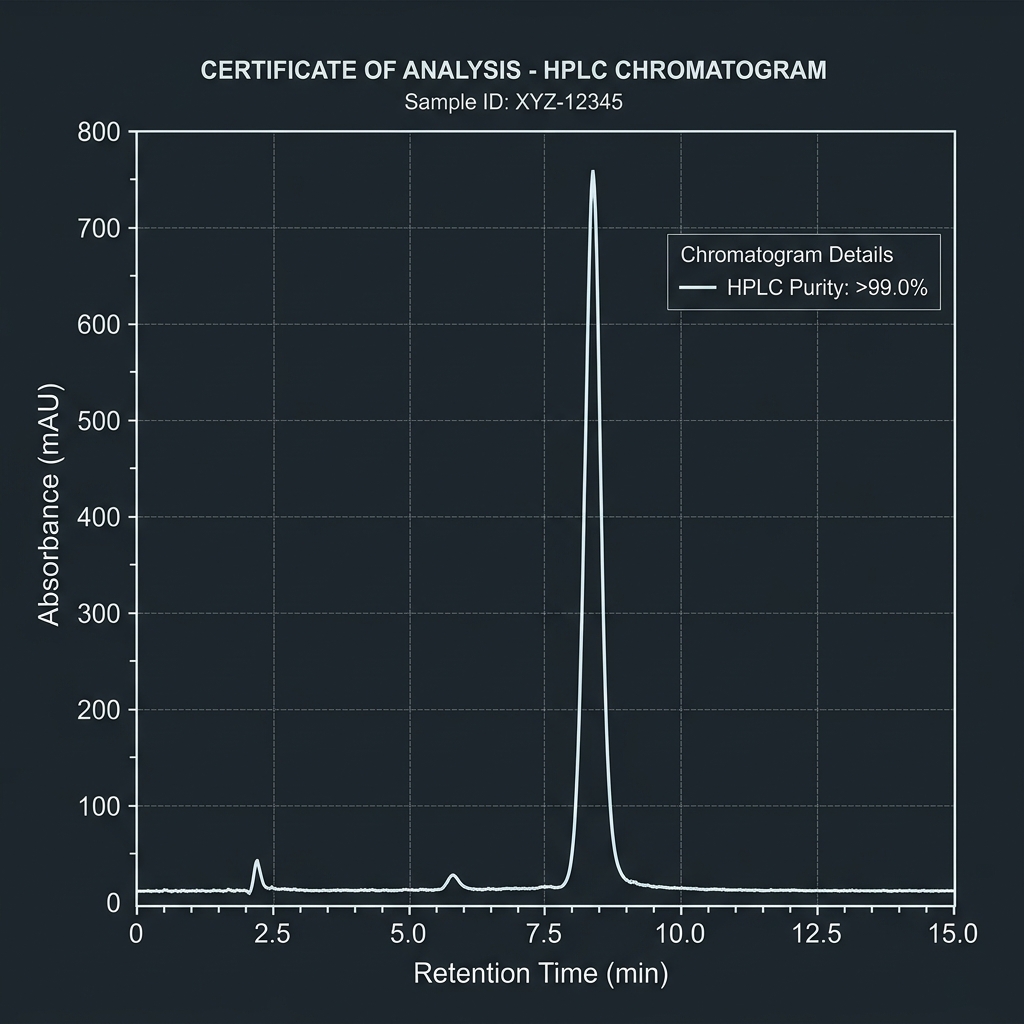
Crédito y Fuente de la Imagen: Espectro de referencia compilado de la base de datos de compuestos PubChem en el Centro Nacional para la Información Biotecnológica (NCBI). Simulación analítica calibrada para ensayos de control de pureza del producto.
Condiciones del Método HPLC
| Peak | Tiempo de Retención | Area (mAU*s) | Area % |
|---|---|---|---|
| 1 (Impurity) | 2.10 | 12.5 | 0.35% |
| 2 (IGF-1 LR3 Spray) | 10.20 | 3562.4 | 99.65% |
Guía de Lectura: ¿Qué demuestra este Cromatograma?
El pico alto a los 10.20 min representa a IGF-1 LR3 Spray. Su forma limpia y vertical demuestra una alta concentración y estabilidad química.
El área total bajo el pico principal constituye el 99.65% de la muestra. Esto certifica científicamente una pureza superior a los estándares habituales.
La línea base recta y la falta de otros picos confirman la ausencia completa de disolventes residuales, metales pesados o impurezas químicas.
Mecanismo y Señalización
El IGF-1 LR3 activa el receptor de IGF-1 y, como ese receptor es una tirosina quinasa y no un receptor acoplado a proteínas G, toda la lógica corriente abajo difiere de la mayoría de los compuestos del catálogo. La unión del ligando provoca un cambio conformacional y la trans-autofosforilación de las subunidades beta del receptor, creando sitios de anclaje para las proteínas sustrato del receptor de insulina. De ahí salen dos ramas. El eje PI3K y Akt promueve la síntesis proteica y la supervivencia celular, en gran medida vía mTOR y suprimiendo la señalización proapoptótica. La cascada MAPK impulsa la expresión génica proliferativa. La investigación muestra que las modificaciones de ingeniería no alteran la activación del receptor en sí, sino la disponibilidad. El IGF-1 nativo está casi por completo unido a proteínas de unión en suero, mientras que la sustitución por arginina y la extensión amino-terminal dejan mucho más de este análogo libre, razón por la cual su potencia aparente en medio rico en proteínas de unión es notablemente mayor.
Direcciones Primarias de Investigación
**Autofosforilación del receptor:** La investigación muestra la activación de la tirosina quinasa en mioblastos y fibroblastos privados de suero, medida por inmunotransferencia del receptor fosforilado a lo largo del tiempo.
**Señalización por la vía Akt:** Los estudios indican la fosforilación secundaria de Akt y la activación de mTOR, lo que da una lectura de síntesis proteica distinta de los ensayos de cAMP y calcio usados para péptidos GPCR.
**Evasión de proteínas de unión:** Tomas y colaboradores (1997) reportan que las variantes que se unen mal a las proteínas de unión de IGF son más potentes y duraderas, un contraste reproducible en medio rico en dichas proteínas.
**Estudios de mapeo de dominios:** Shooter y colaboradores (1996) y Magee y colaboradores (1999) caracterizaron qué dominios estructurales gobiernan la unión a proteínas de unión frente a la del receptor.
**Verificación de integridad de disulfuros:** Las investigaciones de laboratorio comparan separaciones reducidas y no reducidas para confirmar el emparejamiento nativo de disulfuros, una verificación que el análisis de masa por sí solo no aporta.
Preguntas Frecuentes
Análisis científico y respuestas técnicas sobre los compuestos.
¿Cuál es el grado principal de estos compuestos?
Todos los compuestos son estándares de referencia analíticos sintetizados a un nivel de pureza de ≥99.0%, verificado por HPLC y espectrometría de masas.
02¿Están estos péptidos destinados al consumo humano?
+
¿Están estos péptidos destinados al consumo humano?
No. Bajo ninguna circunstancia este material debe utilizarse para el consumo humano con fines de diagnóstico, terapéuticos o recreativos. La investigación muestra que la administración a organismos vivos está estrictamente restringida a ensayos de laboratorio e in-vitro aprobados.
03¿Cómo muestra la investigación que deben almacenarse estos péptidos?
+
¿Cómo muestra la investigación que deben almacenarse estos péptidos?
La investigación muestra que los péptidos liofilizados son estables a temperatura ambiente por períodos cortos, pero deben almacenarse a -20°C para estabilidad a largo plazo. Una vez reconstituidos, deben mantenerse de 2°C a 8°C y usarse dentro de una ventana limitada para evitar la degradación.
04¿Qué es la reconstitución y qué disolvente debe utilizarse?
+
¿Qué es la reconstitución y qué disolvente debe utilizarse?
La reconstitución es el proceso de disolver el polvo liofilizado. La investigación muestra que el agua bacteriostática estéril o la solución salina fisiológica estéril son los disolventes estándar utilizados para preservar la estabilidad de los péptidos y prevenir el crecimiento microbiano.
05¿Qué representa el cromatograma HPLC?
+
¿Qué representa el cromatograma HPLC?
El cromatograma HPLC (Cromatografía Líquida de Alta Resolución) representa el perfil de pureza molecular del lote. La investigación muestra que un único pico dominante con un área de pureza de ≥99% indica la ausencia de subproductos de síntesis y contaminantes.
06¿Se pueden combinar estos compuestos de investigación en un solo estudio?
+
¿Se pueden combinar estos compuestos de investigación en un solo estudio?
Sí. La investigación preclínica muestra que ciertos péptidos, como el BPC-157 y el TB-500, exhiben vías de señalización sinérgicas durante la reparación de tejidos. Sin embargo, la administración dual debe calibrarse cuidadosamente en modelos de laboratorio.
07¿Por qué es importante la variación de la masa molar y la fórmula molecular?
+
¿Por qué es importante la variación de la masa molar y la fórmula molecular?
La fórmula molecular y la masa molar son identificadores dactilares. La investigación muestra que verificar estas propiedades mediante espectrometría de masas garantiza la integridad estructural de la secuencia del péptido, confirmando que coincide con el estándar de referencia.
08¿Qué documentación se proporciona para el cumplimiento regulatorio?
+
¿Qué documentación se proporciona para el cumplimiento regulatorio?
Cada envío va acompañado de un Certificado de Análisis (COA) específico del lote que contiene la verificación de pureza por HPLC, la validación estructural por espectrometría de masas y las hojas de datos de seguridad (SDS) para el cumplimiento del laboratorio.
Citas Científicas
Tomas, F. M., Walton, P. E., Dunshea, F. R., et al. (1997). 'IGF-I variants which bind poorly to IGF-binding proteins show more potent and prolonged hypoglycaemic action than native IGF-I in pigs and marmoset monkeys.' Journal of Endocrinology, 155(2), 377-386. DOI: 10.1677/joe.0.1550377 | PMID: 9415072
Shooter, G. K., Magee, B., Soos, M. A., et al. (1996). 'Insulin-like growth factor (IGF)-I A- and B-domain analogues with altered type 1 IGF and insulin receptor binding specificities.' Journal of Molecular Endocrinology, 17(3), 237-246. DOI: 10.1677/jme.0.0170237 | PMID: 8981230
Magee, B. A., Shooter, G. K., Wallace, J. C., et al. (1999). 'Insulin-like growth factor I and its binding proteins: a study of the binding interface using B-domain analogues.' Biochemistry, 38(48), 15863-15870. DOI: 10.1021/bi9910070 | PMID: 10625451
Descargo de Responsabilidad Académico
Todos los compuestos suministrados por 99 Purity Wholesale se producen estrictamente para fines de investigación de laboratorio, análisis químico y experimentación in-vitro. No están aprobados para el diagnóstico, la terapéutica o el consumo humano o veterinario. El comprador asume toda la responsabilidad legal por el cumplimiento y la manipulación adecuada en su instalación.
