
Clinical Research & Reference Standard Compendium
SS-31 Spray - Scientific Literature
I. Abstract & Overview
SS-31, también conocido como elamipretida, es un péptido aromático-catiónico de cuatro residuos diseñado para concentrarse dentro de las mitocondrias sin depender del potencial de membrana. Su diana molecular no es una proteína sino un lípido: la cardiolipina, el fosfolípido de cuatro colas que se encuentra casi exclusivamente en la membrana mitocondrial interna. Birk y colaboradores reportaron en 2013 que el compuesto reactiva las mitocondrias isquémicas específicamente a través de esta interacción con la cardiolipina, y el trabajo posterior de 2014 caracterizó cómo afecta al complejo de citocromo c y cardiolipina. La consecuencia funcional descrita en esa literatura es doble: se estabiliza la arquitectura de las crestas y se impide que la cardiolipina convierta al citocromo c en una peroxidasa, cortando la generación de especies reactivas de oxígeno en su origen. Como la captación es independiente del potencial, el compuesto se acumula incluso en mitocondrias despolarizadas. Uso Exclusivo de Investigación (RUO).
II. Chemical Specifications
| Molecular Formula | C32H49N9O5 |
|---|---|
| Molar Mass | 639.8 g/mol (PubChem CID 11764719, elamipretide) |
| CAS Registry Number | 736992-21-5 |
| Amino Acid Sequence | D-Arg-Dmt-Lys-Phe-NH2 (4 residuos; contiene D-arginina y 2,6-dimetiltirosina, amida C-terminal) |
III. Mechanism & Cellular Signaling Pathways
SS-31 actúa por unión a lípidos y no por activación de receptores, lo que lo hace mecánicamente distinto de todos los demás péptidos de este catálogo. Sus residuos alternantes aromáticos y catiónicos le permiten cruzar membranas sin transportador y repartirse selectivamente hacia la membrana mitocondrial interna, donde se asocia con la cardiolipina. La investigación muestra que de ahí se derivan dos consecuencias. Primero, la unión estabiliza la curvatura pronunciada de las membranas de las crestas, preservando la organización física de la que dependen los supercomplejos de la cadena respiratoria. Segundo, y de forma más específica, interfiere con la interacción entre cardiolipina y citocromo c que convierte al citocromo c de transportador de electrones en peroxidasa, un cambio que impulsa la producción de especies reactivas de oxígeno durante la isquemia. La propiedad que más lo distingue es que la acumulación no requiere un potencial de membrana intacto, a diferencia de las estrategias con cationes lipofílicos que pierden su direccionamiento justo cuando las mitocondrias están dañadas.
IV. Primary Research Directions
- **Ensayos de unión a cardiolipina:** La investigación muestra una asociación directa con la cardiolipina, medible en sistemas de liposomas definidos de composición lipídica controlada y sin componentes celulares.
- **Respiración mitocondrial:** Birk y colaboradores (2013) reportan la restauración del transporte de electrones en mitocondrias isquémicas, cuantificada por consumo de oxígeno en plataformas Seahorse o de electrodo de Clark.
- **Supresión de la actividad peroxidasa del citocromo c:** Birk y colaboradores (2014) describen la interferencia con el complejo de cardiolipina y citocromo c, el interruptor que impulsa la generación de especies reactivas de oxígeno.
- **Captación independiente del potencial:** Los estudios indican que la acumulación no requiere un potencial de membrana intacto, lo que permite la comparación directa con enfoques de cationes lipofílicos en preparaciones despolarizadas.
- **Protección mitocondrial endotelial:** Liu y colaboradores (2014) reportan mitocondrias endoteliales preservadas y menor rarefacción microvascular en modelos de isquemia renal.
V. Frequently Asked Questions (FAQs)
Q: ¿Cuál es el grado principal de estos compuestos?
Todos los compuestos son estándares de referencia analíticos sintetizados a un nivel de pureza de ≥99.0%, verificado por HPLC y espectrometría de masas.
Q: ¿Están estos péptidos destinados al consumo humano?
No. Bajo ninguna circunstancia este material debe utilizarse para el consumo humano con fines de diagnóstico, terapéuticos o recreativos. La investigación muestra que la administración a organismos vivos está estrictamente restringida a ensayos de laboratorio e in-vitro aprobados.
Q: ¿Cómo muestra la investigación que deben almacenarse estos péptidos?
La investigación muestra que los péptidos liofilizados son estables a temperatura ambiente por períodos cortos, pero deben almacenarse a -20°C para estabilidad a largo plazo. Una vez reconstituidos, deben mantenerse de 2°C a 8°C y usarse dentro de una ventana limitada para evitar la degradación.
Q: ¿Qué es la reconstitución y qué disolvente debe utilizarse?
La reconstitución es el proceso de disolver el polvo liofilizado. La investigación muestra que el agua bacteriostática estéril o la solución salina fisiológica estéril son los disolventes estándar utilizados para preservar la estabilidad de los péptidos y prevenir el crecimiento microbiano.
Q: ¿Qué representa el cromatograma HPLC?
El cromatograma HPLC (Cromatografía Líquida de Alta Resolución) representa el perfil de pureza molecular del lote. La investigación muestra que un único pico dominante con un área de pureza de ≥99% indica la ausencia de subproductos de síntesis y contaminantes.
Q: ¿Se pueden combinar estos compuestos de investigación en un solo estudio?
Sí. La investigación preclínica muestra que ciertos péptidos, como el BPC-157 y el TB-500, exhiben vías de señalización sinérgicas durante la reparación de tejidos. Sin embargo, la administración dual debe calibrarse cuidadosamente en modelos de laboratorio.
Q: ¿Por qué es importante la variación de la masa molar y la fórmula molecular?
La fórmula molecular y la masa molar son identificadores dactilares. La investigación muestra que verificar estas propiedades mediante espectrometría de masas garantiza la integridad estructural de la secuencia del péptido, confirmando que coincide con el estándar de referencia.
Q: ¿Qué documentación se proporciona para el cumplimiento regulatorio?
Cada envío va acompañado de un Certificado de Análisis (COA) específico del lote que contiene la verificación de pureza por HPLC, la validación estructural por espectrometría de masas y las hojas de datos de seguridad (SDS) para el cumplimiento del laboratorio.
VI. Academic Citations
- Birk, A. V., Liu, S., Soong, Y., et al. (2013). 'The mitochondrial-targeted compound SS-31 re-energizes ischemic mitochondria by interacting with cardiolipin.' Journal of the American Society of Nephrology, 24(8), 1250-1261. DOI: 10.1681/ASN.2012121216 | PMID: 23813215
- Birk, A. V., Chao, W. M., Bracken, C., et al. (2014). 'Targeting mitochondrial cardiolipin and the cytochrome c/cardiolipin complex to promote electron transport and optimize mitochondrial ATP synthesis.' British Journal of Pharmacology, 171(8), 2017-2028. DOI: 10.1111/bph.12468 | PMID: 24134698
- Liu, S., Soong, Y., Seshan, S. V., et al. (2014). 'Novel cardiolipin therapeutic protects endothelial mitochondria during renal ischemia and mitigates microvascular rarefaction, inflammation, and fibrosis.' American Journal of Physiology - Renal Physiology, 306(9), F970-F980. DOI: 10.1152/ajprenal.00697.2013 | PMID: 24553434
SS-31 Spray
Resumen y Descripción General
SS-31, también conocido como elamipretida, es un péptido aromático-catiónico de cuatro residuos diseñado para concentrarse dentro de las mitocondrias sin depender del potencial de membrana. Su diana molecular no es una proteína sino un lípido: la cardiolipina, el fosfolípido de cuatro colas que se encuentra casi exclusivamente en la membrana mitocondrial interna. Birk y colaboradores reportaron en 2013 que el compuesto reactiva las mitocondrias isquémicas específicamente a través de esta interacción con la cardiolipina, y el trabajo posterior de 2014 caracterizó cómo afecta al complejo de citocromo c y cardiolipina. La consecuencia funcional descrita en esa literatura es doble: se estabiliza la arquitectura de las crestas y se impide que la cardiolipina convierta al citocromo c en una peroxidasa, cortando la generación de especies reactivas de oxígeno en su origen. Como la captación es independiente del potencial, el compuesto se acumula incluso en mitocondrias despolarizadas. Uso Exclusivo de Investigación (RUO).
Especificaciones Técnicas
Verificación HPLC del Lote
CROMATOGRAMA DE REFERENCIA HPLC (ESTÁNDAR ANALÍTICO)
Perfil analítico de alta resolución correspondiente a la pureza del lote de este compuesto. La integración del área del pico confirma una pureza ≥99.0%.
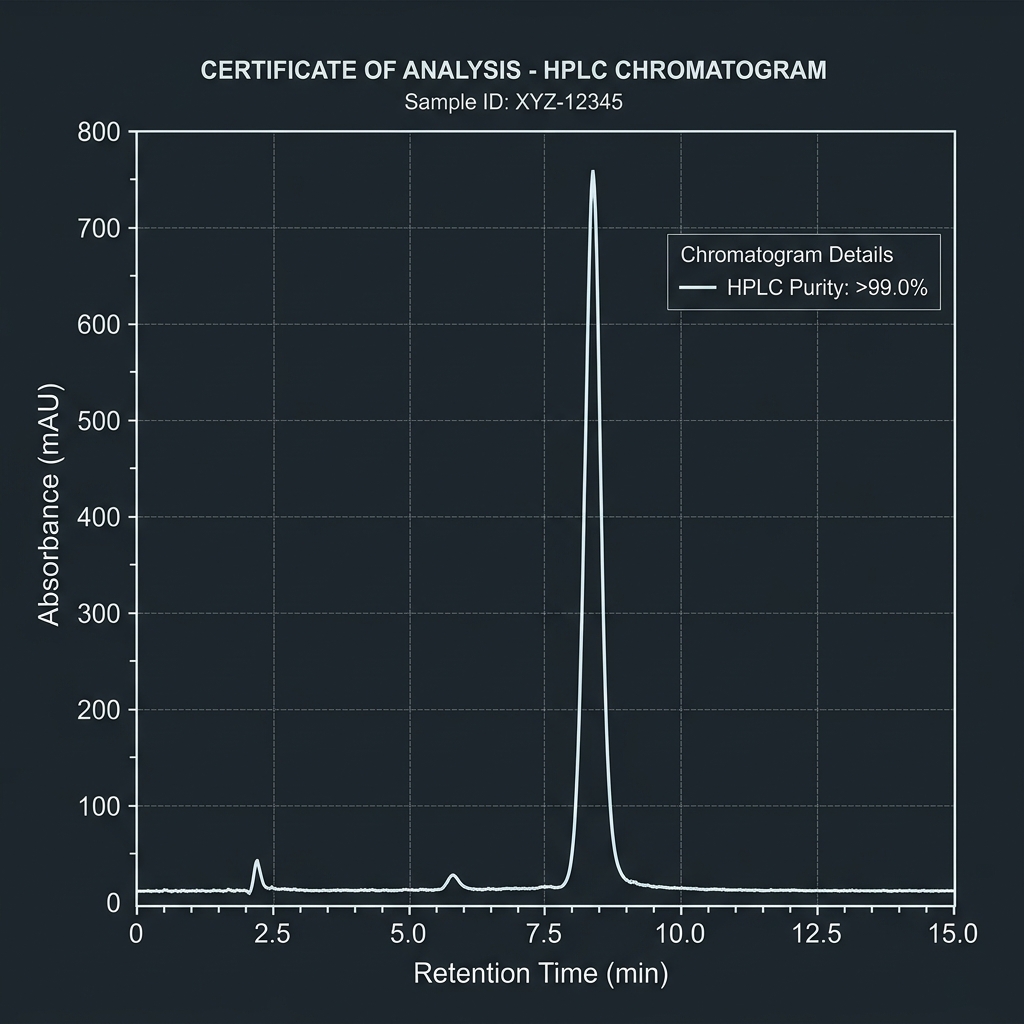
Crédito y Fuente de la Imagen: Espectro de referencia compilado de la base de datos de compuestos PubChem en el Centro Nacional para la Información Biotecnológica (NCBI). Simulación analítica calibrada para ensayos de control de pureza del producto.
Condiciones del Método HPLC
| Peak | Tiempo de Retención | Area (mAU*s) | Area % |
|---|---|---|---|
| 1 (Impurity) | 2.10 | 12.5 | 0.35% |
| 2 (SS-31 Spray) | 3.10 | 3562.4 | 99.65% |
Guía de Lectura: ¿Qué demuestra este Cromatograma?
El pico alto a los 3.10 min representa a SS-31 Spray. Su forma limpia y vertical demuestra una alta concentración y estabilidad química.
El área total bajo el pico principal constituye el 99.65% de la muestra. Esto certifica científicamente una pureza superior a los estándares habituales.
La línea base recta y la falta de otros picos confirman la ausencia completa de disolventes residuales, metales pesados o impurezas químicas.
Mecanismo y Señalización
SS-31 actúa por unión a lípidos y no por activación de receptores, lo que lo hace mecánicamente distinto de todos los demás péptidos de este catálogo. Sus residuos alternantes aromáticos y catiónicos le permiten cruzar membranas sin transportador y repartirse selectivamente hacia la membrana mitocondrial interna, donde se asocia con la cardiolipina. La investigación muestra que de ahí se derivan dos consecuencias. Primero, la unión estabiliza la curvatura pronunciada de las membranas de las crestas, preservando la organización física de la que dependen los supercomplejos de la cadena respiratoria. Segundo, y de forma más específica, interfiere con la interacción entre cardiolipina y citocromo c que convierte al citocromo c de transportador de electrones en peroxidasa, un cambio que impulsa la producción de especies reactivas de oxígeno durante la isquemia. La propiedad que más lo distingue es que la acumulación no requiere un potencial de membrana intacto, a diferencia de las estrategias con cationes lipofílicos que pierden su direccionamiento justo cuando las mitocondrias están dañadas.
Direcciones Primarias de Investigación
**Ensayos de unión a cardiolipina:** La investigación muestra una asociación directa con la cardiolipina, medible en sistemas de liposomas definidos de composición lipídica controlada y sin componentes celulares.
**Respiración mitocondrial:** Birk y colaboradores (2013) reportan la restauración del transporte de electrones en mitocondrias isquémicas, cuantificada por consumo de oxígeno en plataformas Seahorse o de electrodo de Clark.
**Supresión de la actividad peroxidasa del citocromo c:** Birk y colaboradores (2014) describen la interferencia con el complejo de cardiolipina y citocromo c, el interruptor que impulsa la generación de especies reactivas de oxígeno.
**Captación independiente del potencial:** Los estudios indican que la acumulación no requiere un potencial de membrana intacto, lo que permite la comparación directa con enfoques de cationes lipofílicos en preparaciones despolarizadas.
**Protección mitocondrial endotelial:** Liu y colaboradores (2014) reportan mitocondrias endoteliales preservadas y menor rarefacción microvascular en modelos de isquemia renal.
Preguntas Frecuentes
Análisis científico y respuestas técnicas sobre los compuestos.
¿Cuál es el grado principal de estos compuestos?
Todos los compuestos son estándares de referencia analíticos sintetizados a un nivel de pureza de ≥99.0%, verificado por HPLC y espectrometría de masas.
02¿Están estos péptidos destinados al consumo humano?
+
¿Están estos péptidos destinados al consumo humano?
No. Bajo ninguna circunstancia este material debe utilizarse para el consumo humano con fines de diagnóstico, terapéuticos o recreativos. La investigación muestra que la administración a organismos vivos está estrictamente restringida a ensayos de laboratorio e in-vitro aprobados.
03¿Cómo muestra la investigación que deben almacenarse estos péptidos?
+
¿Cómo muestra la investigación que deben almacenarse estos péptidos?
La investigación muestra que los péptidos liofilizados son estables a temperatura ambiente por períodos cortos, pero deben almacenarse a -20°C para estabilidad a largo plazo. Una vez reconstituidos, deben mantenerse de 2°C a 8°C y usarse dentro de una ventana limitada para evitar la degradación.
04¿Qué es la reconstitución y qué disolvente debe utilizarse?
+
¿Qué es la reconstitución y qué disolvente debe utilizarse?
La reconstitución es el proceso de disolver el polvo liofilizado. La investigación muestra que el agua bacteriostática estéril o la solución salina fisiológica estéril son los disolventes estándar utilizados para preservar la estabilidad de los péptidos y prevenir el crecimiento microbiano.
05¿Qué representa el cromatograma HPLC?
+
¿Qué representa el cromatograma HPLC?
El cromatograma HPLC (Cromatografía Líquida de Alta Resolución) representa el perfil de pureza molecular del lote. La investigación muestra que un único pico dominante con un área de pureza de ≥99% indica la ausencia de subproductos de síntesis y contaminantes.
06¿Se pueden combinar estos compuestos de investigación en un solo estudio?
+
¿Se pueden combinar estos compuestos de investigación en un solo estudio?
Sí. La investigación preclínica muestra que ciertos péptidos, como el BPC-157 y el TB-500, exhiben vías de señalización sinérgicas durante la reparación de tejidos. Sin embargo, la administración dual debe calibrarse cuidadosamente en modelos de laboratorio.
07¿Por qué es importante la variación de la masa molar y la fórmula molecular?
+
¿Por qué es importante la variación de la masa molar y la fórmula molecular?
La fórmula molecular y la masa molar son identificadores dactilares. La investigación muestra que verificar estas propiedades mediante espectrometría de masas garantiza la integridad estructural de la secuencia del péptido, confirmando que coincide con el estándar de referencia.
08¿Qué documentación se proporciona para el cumplimiento regulatorio?
+
¿Qué documentación se proporciona para el cumplimiento regulatorio?
Cada envío va acompañado de un Certificado de Análisis (COA) específico del lote que contiene la verificación de pureza por HPLC, la validación estructural por espectrometría de masas y las hojas de datos de seguridad (SDS) para el cumplimiento del laboratorio.
Citas Científicas
Birk, A. V., Liu, S., Soong, Y., et al. (2013). 'The mitochondrial-targeted compound SS-31 re-energizes ischemic mitochondria by interacting with cardiolipin.' Journal of the American Society of Nephrology, 24(8), 1250-1261. DOI: 10.1681/ASN.2012121216 | PMID: 23813215
Birk, A. V., Chao, W. M., Bracken, C., et al. (2014). 'Targeting mitochondrial cardiolipin and the cytochrome c/cardiolipin complex to promote electron transport and optimize mitochondrial ATP synthesis.' British Journal of Pharmacology, 171(8), 2017-2028. DOI: 10.1111/bph.12468 | PMID: 24134698
Liu, S., Soong, Y., Seshan, S. V., et al. (2014). 'Novel cardiolipin therapeutic protects endothelial mitochondria during renal ischemia and mitigates microvascular rarefaction, inflammation, and fibrosis.' American Journal of Physiology - Renal Physiology, 306(9), F970-F980. DOI: 10.1152/ajprenal.00697.2013 | PMID: 24553434
Descargo de Responsabilidad Académico
Todos los compuestos suministrados por 99 Purity Wholesale se producen estrictamente para fines de investigación de laboratorio, análisis químico y experimentación in-vitro. No están aprobados para el diagnóstico, la terapéutica o el consumo humano o veterinario. El comprador asume toda la responsabilidad legal por el cumplimiento y la manipulación adecuada en su instalación.
