
Clinical Research & Reference Standard Compendium
CJC-1295 (No DAC) Spray - Scientific Literature
I. Abstract & Overview
CJC-1295 without DAC, also catalogued as modified GRF 1-29, is a 29-residue analog of growth hormone-releasing hormone carrying four engineered substitutions relative to the native fragment. Each substitution addresses a specific liability: a D-configured second residue blocks aminopeptidase cleavage, a glutamine substitution removes a deamidation-prone asparagine, an alanine substitution improves stability, and a leucine substitution eliminates the oxidation-prone methionine that Sermorelin retains. Jetté and colleagues characterized the receptor pharmacology of this backbone in 2005 in the context of albumin bioconjugates, and Stepień and colleagues reported activity of the unmodified 29-residue fragment in a neuroendocrine cell line. The compound differs from the DAC version by the absence of the albumin-conjugating group alone. Research Use Only (RUO).
II. Chemical Specifications
| Molecular Formula | C152H252N44O42 |
|---|---|
| Molar Mass | 3367.9 g/mol (PubChem CID 56841945) |
| CAS Registry Number | 863288-34-0 |
| Amino Acid Sequence | 29-residue GHRH analog with four engineered substitutions (D-configured residue 2, glutamine 8, alanine 15, leucine 27), C-terminal amide; no methionine and no free asparagine — verify exact positions with manufacturer COA |
III. Mechanism & Cellular Signaling Pathways
Receptor engagement follows the standard GHRH route: binding to the GHRH receptor on pituitary somatotroph cells couples through Gs to adenylyl cyclase, raising intracellular cAMP and activating protein kinase A, which phosphorylates CREB and drives Pit-1-dependent transcription of the growth hormone gene, increasing both synthesis and release. The distinguishing feature is not the receptor but the backbone. Research shows the four substitutions each remove a specific degradation route rather than altering receptor affinity: blocking aminopeptidase cleavage, eliminating a deamidation site, improving conformational stability, and removing an oxidation-prone residue. Because Sermorelin is the same 29-residue fragment without those changes, and the DAC version is the same modified backbone with an albumin-conjugating group added, this compound sits at the informative midpoint of a three-way comparison.
IV. Primary Research Directions
- **Substitution Value Isolation:** Laboratory investigations pair it against Sermorelin, the same-length unmodified fragment, to measure exactly what four engineered substitutions contribute to stability and duration.
- **GHRH Receptor Pharmacology:** Research shows receptor-mediated cAMP accumulation in cultured pituitary cells and somatotroph-derived lines, generating concentration-response curves for the target.
- **Conjugation Variable Control:** Studies indicate this version and the DAC version share the modified backbone entirely, so pairing them isolates albumin conjugation from receptor pharmacology.
- **Enzymatic Stability Profiling:** Research shows the D-configured second residue blocks aminopeptidase cleavage, measurable by comparing degradation rates against the native fragment side by side.
- **Reduced Degradation Surface:** Studies indicate the substitutions removed both the oxidation-prone methionine and the deamidation-prone asparagine, giving a cleaner stability profile than Sermorelin.
V. Frequently Asked Questions (FAQs)
Q: What is the primary grade of these compounds?
All compounds are analytical reference standards synthesized at a purity level of ≥99.0%, verified by HPLC and Mass Spectrometry.
Q: Are these peptides intended for human consumption?
No. Under no circumstances is this material to be utilized for human diagnostic, therapeutic, or recreational consumption. Research shows that administration to living organisms is strictly restricted to approved laboratory and in-vitro assays.
Q: How does research show these peptides should be stored?
Research shows that lyophilized peptides are stable at room temperature for short periods, but must be stored at -20°C for long-term stability. Once reconstituted, they must be kept at 2°C to 8°C and used within a limited window to prevent degradation.
Q: What is reconstitution and what solvent should be used?
Reconstitution is the process of dissolving the lyophilized powder. Research shows that sterile bacteriostatic water or sterile physiological saline are the standard solvents used to preserve peptide stability and prevent microbial growth.
Q: What does the HPLC chromatogram represent?
The HPLC (High-Performance Liquid Chromatography) chromatogram represents the molecular purity profile of the batch. Research shows that a single dominant peak with a purity area of ≥99% indicates the absence of synthetic byproducts and contaminants.
Q: Can these research compounds be combined in a single study?
Yes. Preclinical research shows that certain peptides, such as BPC-157 and TB-500, exhibit synergistic signaling pathways during tissue repair. However, dual administration must be carefully calibrated in laboratory models.
Q: Why is molar mass and molecular formula variance important?
Molecular formula and molar mass are fingerprinted identifiers. Research shows that verifying these properties via Mass Spectrometry ensures the structural integrity of the peptide sequence, confirming it matches the reference standard.
Q: What documentation is provided for regulatory compliance?
Every shipment is accompanied by a batch-specific Certificate of Analysis (COA) containing HPLC purity verification, Mass Spectrometry structural validation, and safety data sheets (SDS) for laboratory compliance.
VI. Academic Citations
- Jetté, L., Léger, R., Thibaudeau, K., et al. (2005). 'Human growth hormone-releasing factor (hGRF)1-29-albumin bioconjugates activate the GRF receptor on the anterior pituitary in rats.' Endocrinology, 146(7), 3052-3058. DOI: 10.1210/en.2004-1286 | PMID: 15817669
- Stepień, T., Sacewicz, M., Lawnicka, H., et al. (2009). 'Stimulatory effect of growth hormone-releasing hormone (GHRH(1-29)NH2) on the proliferation, VEGF and chromogranin A secretion by human neuroendocrine tumor cell line NCI-H727 in vitro.' Neuropeptides, 43(5), 397-400. DOI: 10.1016/j.npep.2009.08.005 | PMID: 19747727
- Halmos, G., Szabo, Z., Juhasz, E., et al. (2023). 'Signaling mechanism of growth hormone-releasing hormone receptor.' Vitamins and Hormones, 123, 1-26. DOI: 10.1016/bs.vh.2023.06.004 | PMID: 37717982
CJC-1295 (No DAC) Spray
Abstract & Overview
CJC-1295 without DAC, also catalogued as modified GRF 1-29, is a 29-residue analog of growth hormone-releasing hormone carrying four engineered substitutions relative to the native fragment. Each substitution addresses a specific liability: a D-configured second residue blocks aminopeptidase cleavage, a glutamine substitution removes a deamidation-prone asparagine, an alanine substitution improves stability, and a leucine substitution eliminates the oxidation-prone methionine that Sermorelin retains. Jetté and colleagues characterized the receptor pharmacology of this backbone in 2005 in the context of albumin bioconjugates, and Stepień and colleagues reported activity of the unmodified 29-residue fragment in a neuroendocrine cell line. The compound differs from the DAC version by the absence of the albumin-conjugating group alone. Research Use Only (RUO).
Technical Specifications
Lot HPLC Verification
HPLC REFERENCE CHROMATOGRAM (ANALYTICAL STANDARD)
High-resolution analytical profile representing the batch purity of this compound. Peak area integration confirms purity verification of ≥99.0%.
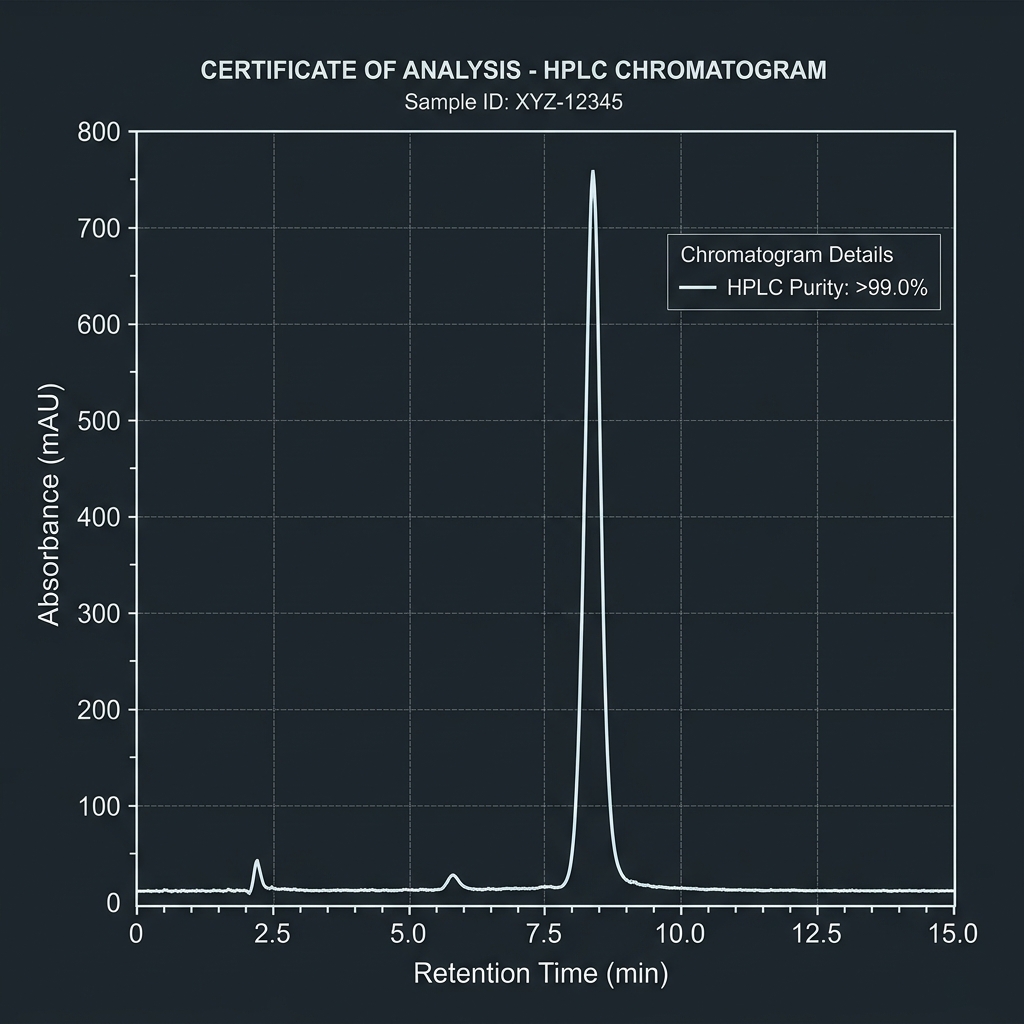
Image Credit & Source: Reference spectrum compiled from the PubChem compound database at the National Center for Biotechnology Information (NCBI). Calibrated analytical simulation for product purity control assays.
HPLC Method Conditions
| Peak | Retention Time | Area (mAU*s) | Area % |
|---|---|---|---|
| 1 (Impurity) | 2.10 | 12.5 | 0.35% |
| 2 (CJC-1295 (No DAC) Spray) | 8.10 | 3562.4 | 99.65% |
How to Read This Report: What Does This Graph Prove?
The tall spike at 8.10 minutes represents the active compound (CJC-1295 (No DAC) Spray). A single clean, tall peak confirms high concentration.
The total area under the main peak accounts for 99.65% of the material. This mathematically verifies the high-purity rating of the batch.
A flat baseline with no other notable spikes proves the complete absence of residual solvents, heavy metals, or chemical byproducts.
Mechanism & Signaling
Receptor engagement follows the standard GHRH route: binding to the GHRH receptor on pituitary somatotroph cells couples through Gs to adenylyl cyclase, raising intracellular cAMP and activating protein kinase A, which phosphorylates CREB and drives Pit-1-dependent transcription of the growth hormone gene, increasing both synthesis and release. The distinguishing feature is not the receptor but the backbone. Research shows the four substitutions each remove a specific degradation route rather than altering receptor affinity: blocking aminopeptidase cleavage, eliminating a deamidation site, improving conformational stability, and removing an oxidation-prone residue. Because Sermorelin is the same 29-residue fragment without those changes, and the DAC version is the same modified backbone with an albumin-conjugating group added, this compound sits at the informative midpoint of a three-way comparison.
Primary Research Directions
**Substitution Value Isolation:** Laboratory investigations pair it against Sermorelin, the same-length unmodified fragment, to measure exactly what four engineered substitutions contribute to stability and duration.
**GHRH Receptor Pharmacology:** Research shows receptor-mediated cAMP accumulation in cultured pituitary cells and somatotroph-derived lines, generating concentration-response curves for the target.
**Conjugation Variable Control:** Studies indicate this version and the DAC version share the modified backbone entirely, so pairing them isolates albumin conjugation from receptor pharmacology.
**Enzymatic Stability Profiling:** Research shows the D-configured second residue blocks aminopeptidase cleavage, measurable by comparing degradation rates against the native fragment side by side.
**Reduced Degradation Surface:** Studies indicate the substitutions removed both the oxidation-prone methionine and the deamidation-prone asparagine, giving a cleaner stability profile than Sermorelin.
Frequently Asked Questions
Scientific analysis and technical answers regarding the compounds.
What is the primary grade of these compounds?
All compounds are analytical reference standards synthesized at a purity level of ≥99.0%, verified by HPLC and Mass Spectrometry.
02Are these peptides intended for human consumption?
+
Are these peptides intended for human consumption?
No. Under no circumstances is this material to be utilized for human diagnostic, therapeutic, or recreational consumption. Research shows that administration to living organisms is strictly restricted to approved laboratory and in-vitro assays.
03How does research show these peptides should be stored?
+
How does research show these peptides should be stored?
Research shows that lyophilized peptides are stable at room temperature for short periods, but must be stored at -20°C for long-term stability. Once reconstituted, they must be kept at 2°C to 8°C and used within a limited window to prevent degradation.
04What is reconstitution and what solvent should be used?
+
What is reconstitution and what solvent should be used?
Reconstitution is the process of dissolving the lyophilized powder. Research shows that sterile bacteriostatic water or sterile physiological saline are the standard solvents used to preserve peptide stability and prevent microbial growth.
05What does the HPLC chromatogram represent?
+
What does the HPLC chromatogram represent?
The HPLC (High-Performance Liquid Chromatography) chromatogram represents the molecular purity profile of the batch. Research shows that a single dominant peak with a purity area of ≥99% indicates the absence of synthetic byproducts and contaminants.
06Can these research compounds be combined in a single study?
+
Can these research compounds be combined in a single study?
Yes. Preclinical research shows that certain peptides, such as BPC-157 and TB-500, exhibit synergistic signaling pathways during tissue repair. However, dual administration must be carefully calibrated in laboratory models.
07Why is molar mass and molecular formula variance important?
+
Why is molar mass and molecular formula variance important?
Molecular formula and molar mass are fingerprinted identifiers. Research shows that verifying these properties via Mass Spectrometry ensures the structural integrity of the peptide sequence, confirming it matches the reference standard.
08What documentation is provided for regulatory compliance?
+
What documentation is provided for regulatory compliance?
Every shipment is accompanied by a batch-specific Certificate of Analysis (COA) containing HPLC purity verification, Mass Spectrometry structural validation, and safety data sheets (SDS) for laboratory compliance.
Scientific Citations
Jetté, L., Léger, R., Thibaudeau, K., et al. (2005). 'Human growth hormone-releasing factor (hGRF)1-29-albumin bioconjugates activate the GRF receptor on the anterior pituitary in rats.' Endocrinology, 146(7), 3052-3058. DOI: 10.1210/en.2004-1286 | PMID: 15817669
Stepień, T., Sacewicz, M., Lawnicka, H., et al. (2009). 'Stimulatory effect of growth hormone-releasing hormone (GHRH(1-29)NH2) on the proliferation, VEGF and chromogranin A secretion by human neuroendocrine tumor cell line NCI-H727 in vitro.' Neuropeptides, 43(5), 397-400. DOI: 10.1016/j.npep.2009.08.005 | PMID: 19747727
Halmos, G., Szabo, Z., Juhasz, E., et al. (2023). 'Signaling mechanism of growth hormone-releasing hormone receptor.' Vitamins and Hormones, 123, 1-26. DOI: 10.1016/bs.vh.2023.06.004 | PMID: 37717982
Academic Disclaimer
All chemical compounds supplied by 99 Purity Wholesale are strictly engineered and distributed for laboratory research, chemical analysis, and in-vitro testing. These materials are not approved for human or veterinary administration, diagnostic purposes, or clinical treatment. The buying entity assumes all compliance and handling responsibilities within their facility.
