
Clinical Research & Reference Standard Compendium
Glutathione Spray - Scientific Literature
I. Abstract & Overview
Glutathione is a tripeptide of glutamate, cysteine and glycine distinguished by an unusual gamma-glutamyl linkage in which the glutamate side-chain carboxyl rather than its backbone carboxyl forms the peptide bond. That arrangement renders the molecule resistant to ordinary peptidases and accounts for its persistence as the dominant intracellular thiol. Lu reviewed the biosynthetic pathway and its regulation in 2013, and Forman, Zhang and Rinna covered its protective roles and the methodology for measuring it in 2009. The cysteine thiol is the functional centre: glutathione peroxidase consumes two molecules to reduce a peroxide and glutathione reductase regenerates them using NADPH, while glutathione S-transferase enzymes use the same thiol as a conjugating nucleophile. The ratio of reduced to oxidised form indexes cellular redox state. Research Use Only (RUO).
II. Chemical Specifications
| Molecular Formula | C10H17N3O6S |
|---|---|
| Molar Mass | 307.33 g/mol (PubChem CID 124886) |
| CAS Registry Number | 70-18-8 |
| Amino Acid Sequence | gamma-Glu-Cys-Gly (3 residues; the glutamate joins through its side-chain carboxyl, not the backbone, which blocks ordinary peptidase cleavage) |
III. Mechanism & Cellular Signaling Pathways
Glutathione functions as an enzyme cofactor and conjugating substrate rather than as a ligand, which places it alongside L-Carnitine as one of the few non-signaling compounds in this catalog. Two structural features govern its behaviour. The gamma-glutamyl linkage, formed through the glutamate side chain instead of the backbone, blocks cleavage by conventional peptidases and gives the tripeptide an unusually long intracellular residence. The cysteine thiol performs the chemistry. In the peroxidase reaction two glutathione molecules donate electrons to reduce hydrogen peroxide or a lipid peroxide, becoming linked as the oxidised disulfide dimer, which glutathione reductase then reduces back using NADPH as the electron source. Separately, glutathione S-transferase enzymes use the same thiol to conjugate electrophilic compounds. Research shows the reduced to oxidised ratio serves as the standard quantitative readout of redox state.
IV. Primary Research Directions
- **Redox State Quantification:** Research shows the reduced to oxidised ratio is the accepted index of cellular redox balance, measured by separating both species rather than reporting total glutathione.
- **Peroxidase Enzyme Assays:** Studies indicate glutathione serves as the electron donor in glutathione peroxidase reactions, with turnover followed spectrophotometrically through NADPH consumption.
- **Conjugation Chemistry:** Laboratory investigations use the same thiol as the conjugating nucleophile in glutathione S-transferase assays, a distinct enzymatic readout from the peroxidase route.
- **Oxidative Challenge Models:** Research shows measurable ratio shifts when cultures are challenged with an oxidant, the standard design for studying redox buffering capacity.
- **Biosynthesis Pathway Studies:** Lu (2013) reviewed glutathione synthesis and its regulation, providing the framework labs use when manipulating precursor availability in culture.
V. Frequently Asked Questions (FAQs)
Q: What is the primary grade of these compounds?
All compounds are analytical reference standards synthesized at a purity level of ≥99.0%, verified by HPLC and Mass Spectrometry.
Q: Are these peptides intended for human consumption?
No. Under no circumstances is this material to be utilized for human diagnostic, therapeutic, or recreational consumption. Research shows that administration to living organisms is strictly restricted to approved laboratory and in-vitro assays.
Q: How does research show these peptides should be stored?
Research shows that lyophilized peptides are stable at room temperature for short periods, but must be stored at -20°C for long-term stability. Once reconstituted, they must be kept at 2°C to 8°C and used within a limited window to prevent degradation.
Q: What is reconstitution and what solvent should be used?
Reconstitution is the process of dissolving the lyophilized powder. Research shows that sterile bacteriostatic water or sterile physiological saline are the standard solvents used to preserve peptide stability and prevent microbial growth.
Q: What does the HPLC chromatogram represent?
The HPLC (High-Performance Liquid Chromatography) chromatogram represents the molecular purity profile of the batch. Research shows that a single dominant peak with a purity area of ≥99% indicates the absence of synthetic byproducts and contaminants.
Q: Can these research compounds be combined in a single study?
Yes. Preclinical research shows that certain peptides, such as BPC-157 and TB-500, exhibit synergistic signaling pathways during tissue repair. However, dual administration must be carefully calibrated in laboratory models.
Q: Why is molar mass and molecular formula variance important?
Molecular formula and molar mass are fingerprinted identifiers. Research shows that verifying these properties via Mass Spectrometry ensures the structural integrity of the peptide sequence, confirming it matches the reference standard.
Q: What documentation is provided for regulatory compliance?
Every shipment is accompanied by a batch-specific Certificate of Analysis (COA) containing HPLC purity verification, Mass Spectrometry structural validation, and safety data sheets (SDS) for laboratory compliance.
VI. Academic Citations
- Lu, S. C. (2013). 'Glutathione synthesis.' Biochimica et Biophysica Acta - General Subjects, 1830(5), 3143-3153. DOI: 10.1016/j.bbagen.2012.09.008 | PMID: 22995213
- Forman, H. J., Zhang, H., & Rinna, A. (2009). 'Glutathione: overview of its protective roles, measurement, and biosynthesis.' Molecular Aspects of Medicine, 30(1-2), 1-12. DOI: 10.1016/j.mam.2008.08.006 | PMID: 18796312
- Huang, C. S., He, W., & Meister, A. (1995). 'Amino acid sequence of rat kidney glutathione synthetase.' PNAS, 92(4), 1232-1236. DOI: 10.1073/pnas.92.4.1232 | PMID: 7862666
Glutathione Spray
Abstract & Overview
Glutathione is a tripeptide of glutamate, cysteine and glycine distinguished by an unusual gamma-glutamyl linkage in which the glutamate side-chain carboxyl rather than its backbone carboxyl forms the peptide bond. That arrangement renders the molecule resistant to ordinary peptidases and accounts for its persistence as the dominant intracellular thiol. Lu reviewed the biosynthetic pathway and its regulation in 2013, and Forman, Zhang and Rinna covered its protective roles and the methodology for measuring it in 2009. The cysteine thiol is the functional centre: glutathione peroxidase consumes two molecules to reduce a peroxide and glutathione reductase regenerates them using NADPH, while glutathione S-transferase enzymes use the same thiol as a conjugating nucleophile. The ratio of reduced to oxidised form indexes cellular redox state. Research Use Only (RUO).
Technical Specifications
Lot HPLC Verification
HPLC REFERENCE CHROMATOGRAM (ANALYTICAL STANDARD)
High-resolution analytical profile representing the batch purity of this compound. Peak area integration confirms purity verification of ≥99.0%.
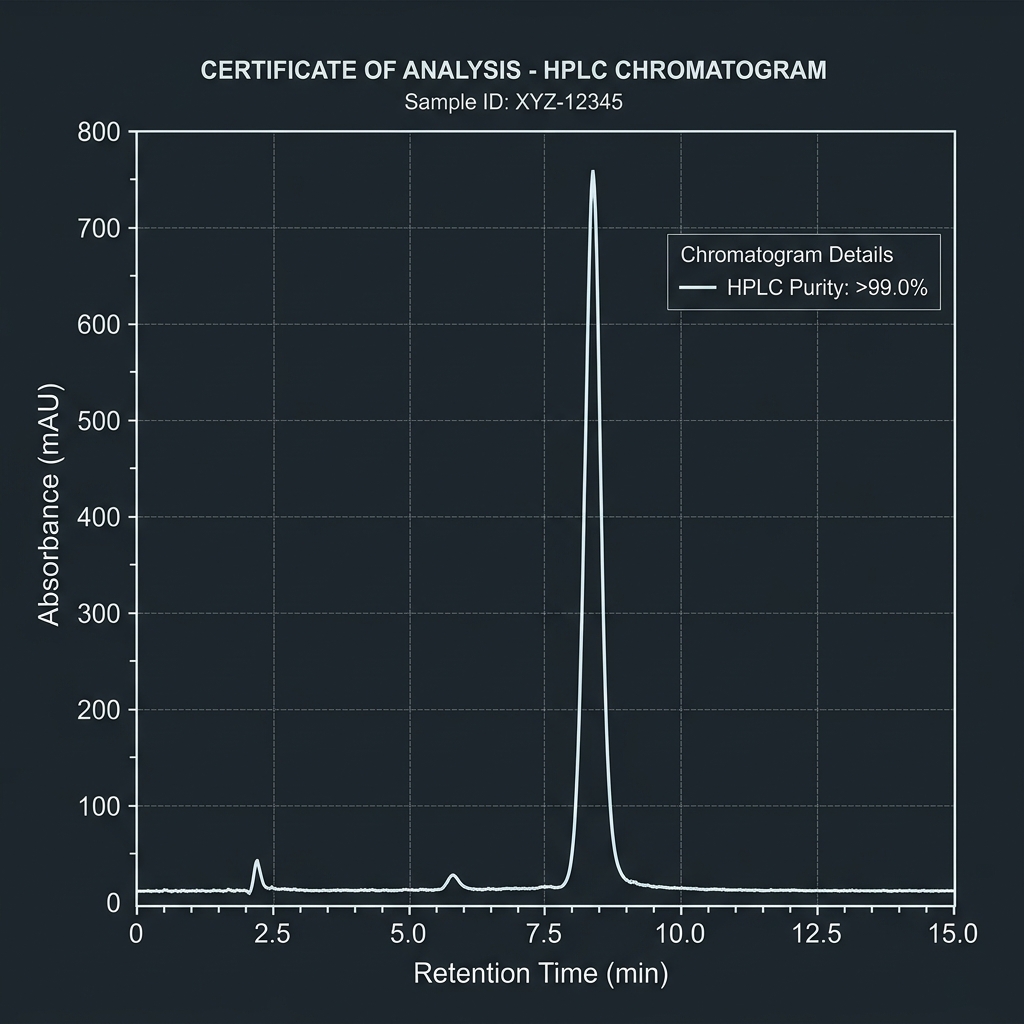
Image Credit & Source: Reference spectrum compiled from the PubChem compound database at the National Center for Biotechnology Information (NCBI). Calibrated analytical simulation for product purity control assays.
HPLC Method Conditions
| Peak | Retention Time | Area (mAU*s) | Area % |
|---|---|---|---|
| 1 (Impurity) | 2.10 | 12.5 | 0.35% |
| 2 (Glutathione Spray) | 2.10 | 3562.4 | 99.65% |
How to Read This Report: What Does This Graph Prove?
The tall spike at 2.10 minutes represents the active compound (Glutathione Spray). A single clean, tall peak confirms high concentration.
The total area under the main peak accounts for 99.65% of the material. This mathematically verifies the high-purity rating of the batch.
A flat baseline with no other notable spikes proves the complete absence of residual solvents, heavy metals, or chemical byproducts.
Mechanism & Signaling
Glutathione functions as an enzyme cofactor and conjugating substrate rather than as a ligand, which places it alongside L-Carnitine as one of the few non-signaling compounds in this catalog. Two structural features govern its behaviour. The gamma-glutamyl linkage, formed through the glutamate side chain instead of the backbone, blocks cleavage by conventional peptidases and gives the tripeptide an unusually long intracellular residence. The cysteine thiol performs the chemistry. In the peroxidase reaction two glutathione molecules donate electrons to reduce hydrogen peroxide or a lipid peroxide, becoming linked as the oxidised disulfide dimer, which glutathione reductase then reduces back using NADPH as the electron source. Separately, glutathione S-transferase enzymes use the same thiol to conjugate electrophilic compounds. Research shows the reduced to oxidised ratio serves as the standard quantitative readout of redox state.
Primary Research Directions
**Redox State Quantification:** Research shows the reduced to oxidised ratio is the accepted index of cellular redox balance, measured by separating both species rather than reporting total glutathione.
**Peroxidase Enzyme Assays:** Studies indicate glutathione serves as the electron donor in glutathione peroxidase reactions, with turnover followed spectrophotometrically through NADPH consumption.
**Conjugation Chemistry:** Laboratory investigations use the same thiol as the conjugating nucleophile in glutathione S-transferase assays, a distinct enzymatic readout from the peroxidase route.
**Oxidative Challenge Models:** Research shows measurable ratio shifts when cultures are challenged with an oxidant, the standard design for studying redox buffering capacity.
**Biosynthesis Pathway Studies:** Lu (2013) reviewed glutathione synthesis and its regulation, providing the framework labs use when manipulating precursor availability in culture.
Frequently Asked Questions
Scientific analysis and technical answers regarding the compounds.
What is the primary grade of these compounds?
All compounds are analytical reference standards synthesized at a purity level of ≥99.0%, verified by HPLC and Mass Spectrometry.
02Are these peptides intended for human consumption?
+
Are these peptides intended for human consumption?
No. Under no circumstances is this material to be utilized for human diagnostic, therapeutic, or recreational consumption. Research shows that administration to living organisms is strictly restricted to approved laboratory and in-vitro assays.
03How does research show these peptides should be stored?
+
How does research show these peptides should be stored?
Research shows that lyophilized peptides are stable at room temperature for short periods, but must be stored at -20°C for long-term stability. Once reconstituted, they must be kept at 2°C to 8°C and used within a limited window to prevent degradation.
04What is reconstitution and what solvent should be used?
+
What is reconstitution and what solvent should be used?
Reconstitution is the process of dissolving the lyophilized powder. Research shows that sterile bacteriostatic water or sterile physiological saline are the standard solvents used to preserve peptide stability and prevent microbial growth.
05What does the HPLC chromatogram represent?
+
What does the HPLC chromatogram represent?
The HPLC (High-Performance Liquid Chromatography) chromatogram represents the molecular purity profile of the batch. Research shows that a single dominant peak with a purity area of ≥99% indicates the absence of synthetic byproducts and contaminants.
06Can these research compounds be combined in a single study?
+
Can these research compounds be combined in a single study?
Yes. Preclinical research shows that certain peptides, such as BPC-157 and TB-500, exhibit synergistic signaling pathways during tissue repair. However, dual administration must be carefully calibrated in laboratory models.
07Why is molar mass and molecular formula variance important?
+
Why is molar mass and molecular formula variance important?
Molecular formula and molar mass are fingerprinted identifiers. Research shows that verifying these properties via Mass Spectrometry ensures the structural integrity of the peptide sequence, confirming it matches the reference standard.
08What documentation is provided for regulatory compliance?
+
What documentation is provided for regulatory compliance?
Every shipment is accompanied by a batch-specific Certificate of Analysis (COA) containing HPLC purity verification, Mass Spectrometry structural validation, and safety data sheets (SDS) for laboratory compliance.
Scientific Citations
Lu, S. C. (2013). 'Glutathione synthesis.' Biochimica et Biophysica Acta - General Subjects, 1830(5), 3143-3153. DOI: 10.1016/j.bbagen.2012.09.008 | PMID: 22995213
Forman, H. J., Zhang, H., & Rinna, A. (2009). 'Glutathione: overview of its protective roles, measurement, and biosynthesis.' Molecular Aspects of Medicine, 30(1-2), 1-12. DOI: 10.1016/j.mam.2008.08.006 | PMID: 18796312
Huang, C. S., He, W., & Meister, A. (1995). 'Amino acid sequence of rat kidney glutathione synthetase.' PNAS, 92(4), 1232-1236. DOI: 10.1073/pnas.92.4.1232 | PMID: 7862666
Academic Disclaimer
All chemical compounds supplied by 99 Purity Wholesale are strictly engineered and distributed for laboratory research, chemical analysis, and in-vitro testing. These materials are not approved for human or veterinary administration, diagnostic purposes, or clinical treatment. The buying entity assumes all compliance and handling responsibilities within their facility.
