
Clinical Research & Reference Standard Compendium
HCG Spray - Scientific Literature
I. Abstract & Overview
Human chorionic gonadotropin is a heterodimeric glycoprotein hormone rather than a synthetic peptide, composed of an alpha subunit common to the glycoprotein hormone family paired non-covalently with a hormone-specific beta subunit. It acts at the luteinizing hormone and choriogonadotropin receptor, a G protein-coupled receptor that Ascoli, Fanelli and Segaloff reviewed comprehensively in 2002 in what remains the standard reference for the target. Receptor activation raises cAMP and drives steroidogenesis through upregulation of the steroidogenic acute regulatory protein. Andric and Ascoli subsequently described a delayed growth-factor-mediated signaling arm that negatively regulates aromatase expression in granulosa cells. An extended, heavily glycosylated carboxy-terminal segment on the beta subunit accounts for its longer circulating life than luteinizing hormone. Research Use Only (RUO).
II. Chemical Specifications
| Molecular Formula | Not applicable — heterodimeric glycoprotein, not a defined small molecule or peptide |
|---|---|
| Molar Mass | Approximately 36,700 g/mol including carbohydrate — varies with glycosylation; potency is specified in international units rather than mass. Verify with manufacturer COA |
| CAS Registry Number | 9002-61-3 |
| Amino Acid Sequence | Heterodimeric glycoprotein: a 92-residue alpha subunit shared across the glycoprotein hormone family paired non-covalently with a 145-residue hormone-specific beta subunit carrying a glycosylated carboxy-terminal extension — verify with manufacturer COA |
III. Mechanism & Cellular Signaling Pathways
Chorionic gonadotropin acts as an assembled heterodimer; neither subunit alone binds the receptor, which is why dimer integrity is a functional requirement and not merely a quality metric. The alpha subunit is shared across the glycoprotein hormone family while the beta subunit determines which receptor is engaged. The intact dimer binds the luteinizing hormone and choriogonadotropin receptor, coupling through Gs to adenylyl cyclase and raising cAMP, which activates protein kinase A. Protein kinase A upregulates the steroidogenic acute regulatory protein, the gatekeeper that transports cholesterol into mitochondria and thereby sets the rate of steroid hormone synthesis. Research shows a secondary, delayed growth-factor-mediated arm also operates, which Andric and Ascoli described as negatively regulating aromatase expression. The distinguishing structural feature is the carbohydrate-rich carboxy-terminal extension on the beta subunit, absent from luteinizing hormone.
IV. Primary Research Directions
- **Steroidogenesis Assays:** Research shows cAMP accumulation followed by steroid output in granulosa and Leydig cell cultures, the standard two-step readout for receptor function in a preparation.
- **Receptor Pharmacology Reference:** Ascoli and colleagues (2002) reviewed the luteinizing hormone and choriogonadotropin receptor comprehensively, providing the framework for interpreting response curves.
- **Aromatase Regulation:** Andric and Ascoli (2006) describe a delayed growth-factor-mediated signaling arm that negatively regulates aromatase expression in granulosa cells.
- **Shared Receptor Comparison:** Laboratory investigations run chorionic gonadotropin against luteinizing hormone at the same receptor, where the longer-lived glycoprotein gives a distinct response profile.
- **Dimer Integrity Testing:** Studies indicate neither subunit is active alone, making size-based confirmation of the intact heterodimer a functional assay rather than a purity formality.
V. Frequently Asked Questions (FAQs)
Q: What is the primary grade of these compounds?
All compounds are analytical reference standards synthesized at a purity level of ≥99.0%, verified by HPLC and Mass Spectrometry.
Q: Are these peptides intended for human consumption?
No. Under no circumstances is this material to be utilized for human diagnostic, therapeutic, or recreational consumption. Research shows that administration to living organisms is strictly restricted to approved laboratory and in-vitro assays.
Q: How does research show these peptides should be stored?
Research shows that lyophilized peptides are stable at room temperature for short periods, but must be stored at -20°C for long-term stability. Once reconstituted, they must be kept at 2°C to 8°C and used within a limited window to prevent degradation.
Q: What is reconstitution and what solvent should be used?
Reconstitution is the process of dissolving the lyophilized powder. Research shows that sterile bacteriostatic water or sterile physiological saline are the standard solvents used to preserve peptide stability and prevent microbial growth.
Q: What does the HPLC chromatogram represent?
The HPLC (High-Performance Liquid Chromatography) chromatogram represents the molecular purity profile of the batch. Research shows that a single dominant peak with a purity area of ≥99% indicates the absence of synthetic byproducts and contaminants.
Q: Can these research compounds be combined in a single study?
Yes. Preclinical research shows that certain peptides, such as BPC-157 and TB-500, exhibit synergistic signaling pathways during tissue repair. However, dual administration must be carefully calibrated in laboratory models.
Q: Why is molar mass and molecular formula variance important?
Molecular formula and molar mass are fingerprinted identifiers. Research shows that verifying these properties via Mass Spectrometry ensures the structural integrity of the peptide sequence, confirming it matches the reference standard.
Q: What documentation is provided for regulatory compliance?
Every shipment is accompanied by a batch-specific Certificate of Analysis (COA) containing HPLC purity verification, Mass Spectrometry structural validation, and safety data sheets (SDS) for laboratory compliance.
VI. Academic Citations
- Ascoli, M., Fanelli, F., & Segaloff, D. L. (2002). 'The lutropin/choriogonadotropin receptor, a 2002 perspective.' Endocrine Reviews, 23(2), 141-174. DOI: 10.1210/edrv.23.2.0462 | PMID: 11943741
- Andric, N., & Ascoli, M. (2006). 'A delayed gonadotropin-dependent and growth factor-mediated activation of the extracellular signal-regulated kinase 1/2 cascade negatively regulates aromatase expression in granulosa cells.' Molecular Endocrinology, 20(12), 3308-3320. DOI: 10.1210/me.2006-0241 | PMID: 16973759
- Kotani, M., Detheux, M., Vandenbogaerde, A., et al. (2001). 'The metastasis suppressor gene KiSS-1 encodes kisspeptins, the natural ligands of the orphan G protein-coupled receptor GPR54.' Journal of Biological Chemistry, 276(37), 34631-34636. DOI: 10.1074/jbc.M104847200 | PMID: 11457843
HCG Spray
Abstract & Overview
Human chorionic gonadotropin is a heterodimeric glycoprotein hormone rather than a synthetic peptide, composed of an alpha subunit common to the glycoprotein hormone family paired non-covalently with a hormone-specific beta subunit. It acts at the luteinizing hormone and choriogonadotropin receptor, a G protein-coupled receptor that Ascoli, Fanelli and Segaloff reviewed comprehensively in 2002 in what remains the standard reference for the target. Receptor activation raises cAMP and drives steroidogenesis through upregulation of the steroidogenic acute regulatory protein. Andric and Ascoli subsequently described a delayed growth-factor-mediated signaling arm that negatively regulates aromatase expression in granulosa cells. An extended, heavily glycosylated carboxy-terminal segment on the beta subunit accounts for its longer circulating life than luteinizing hormone. Research Use Only (RUO).
Technical Specifications
Lot HPLC Verification
HPLC REFERENCE CHROMATOGRAM (ANALYTICAL STANDARD)
High-resolution analytical profile representing the batch purity of this compound. Peak area integration confirms purity verification of ≥99.0%.
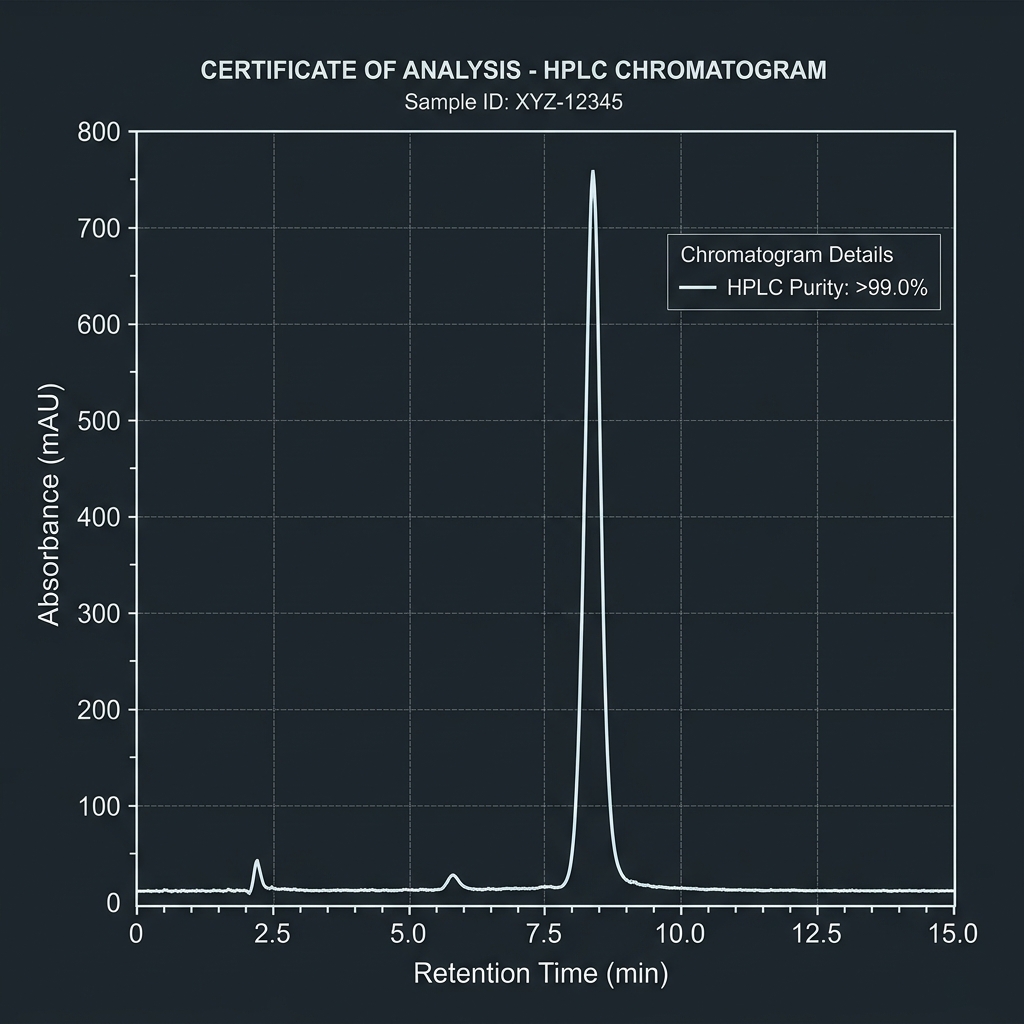
Image Credit & Source: Reference spectrum compiled from the PubChem compound database at the National Center for Biotechnology Information (NCBI). Calibrated analytical simulation for product purity control assays.
HPLC Method Conditions
| Peak | Retention Time | Area (mAU*s) | Area % |
|---|---|---|---|
| 1 (Impurity) | 2.10 | 12.5 | 0.35% |
| 2 (HCG Spray) | 0.00 | 3562.4 | 99.65% |
How to Read This Report: What Does This Graph Prove?
The tall spike at 0.00 minutes represents the active compound (HCG Spray). A single clean, tall peak confirms high concentration.
The total area under the main peak accounts for 99.65% of the material. This mathematically verifies the high-purity rating of the batch.
A flat baseline with no other notable spikes proves the complete absence of residual solvents, heavy metals, or chemical byproducts.
Mechanism & Signaling
Chorionic gonadotropin acts as an assembled heterodimer; neither subunit alone binds the receptor, which is why dimer integrity is a functional requirement and not merely a quality metric. The alpha subunit is shared across the glycoprotein hormone family while the beta subunit determines which receptor is engaged. The intact dimer binds the luteinizing hormone and choriogonadotropin receptor, coupling through Gs to adenylyl cyclase and raising cAMP, which activates protein kinase A. Protein kinase A upregulates the steroidogenic acute regulatory protein, the gatekeeper that transports cholesterol into mitochondria and thereby sets the rate of steroid hormone synthesis. Research shows a secondary, delayed growth-factor-mediated arm also operates, which Andric and Ascoli described as negatively regulating aromatase expression. The distinguishing structural feature is the carbohydrate-rich carboxy-terminal extension on the beta subunit, absent from luteinizing hormone.
Primary Research Directions
**Steroidogenesis Assays:** Research shows cAMP accumulation followed by steroid output in granulosa and Leydig cell cultures, the standard two-step readout for receptor function in a preparation.
**Receptor Pharmacology Reference:** Ascoli and colleagues (2002) reviewed the luteinizing hormone and choriogonadotropin receptor comprehensively, providing the framework for interpreting response curves.
**Aromatase Regulation:** Andric and Ascoli (2006) describe a delayed growth-factor-mediated signaling arm that negatively regulates aromatase expression in granulosa cells.
**Shared Receptor Comparison:** Laboratory investigations run chorionic gonadotropin against luteinizing hormone at the same receptor, where the longer-lived glycoprotein gives a distinct response profile.
**Dimer Integrity Testing:** Studies indicate neither subunit is active alone, making size-based confirmation of the intact heterodimer a functional assay rather than a purity formality.
Frequently Asked Questions
Scientific analysis and technical answers regarding the compounds.
What is the primary grade of these compounds?
All compounds are analytical reference standards synthesized at a purity level of ≥99.0%, verified by HPLC and Mass Spectrometry.
02Are these peptides intended for human consumption?
+
Are these peptides intended for human consumption?
No. Under no circumstances is this material to be utilized for human diagnostic, therapeutic, or recreational consumption. Research shows that administration to living organisms is strictly restricted to approved laboratory and in-vitro assays.
03How does research show these peptides should be stored?
+
How does research show these peptides should be stored?
Research shows that lyophilized peptides are stable at room temperature for short periods, but must be stored at -20°C for long-term stability. Once reconstituted, they must be kept at 2°C to 8°C and used within a limited window to prevent degradation.
04What is reconstitution and what solvent should be used?
+
What is reconstitution and what solvent should be used?
Reconstitution is the process of dissolving the lyophilized powder. Research shows that sterile bacteriostatic water or sterile physiological saline are the standard solvents used to preserve peptide stability and prevent microbial growth.
05What does the HPLC chromatogram represent?
+
What does the HPLC chromatogram represent?
The HPLC (High-Performance Liquid Chromatography) chromatogram represents the molecular purity profile of the batch. Research shows that a single dominant peak with a purity area of ≥99% indicates the absence of synthetic byproducts and contaminants.
06Can these research compounds be combined in a single study?
+
Can these research compounds be combined in a single study?
Yes. Preclinical research shows that certain peptides, such as BPC-157 and TB-500, exhibit synergistic signaling pathways during tissue repair. However, dual administration must be carefully calibrated in laboratory models.
07Why is molar mass and molecular formula variance important?
+
Why is molar mass and molecular formula variance important?
Molecular formula and molar mass are fingerprinted identifiers. Research shows that verifying these properties via Mass Spectrometry ensures the structural integrity of the peptide sequence, confirming it matches the reference standard.
08What documentation is provided for regulatory compliance?
+
What documentation is provided for regulatory compliance?
Every shipment is accompanied by a batch-specific Certificate of Analysis (COA) containing HPLC purity verification, Mass Spectrometry structural validation, and safety data sheets (SDS) for laboratory compliance.
Scientific Citations
Ascoli, M., Fanelli, F., & Segaloff, D. L. (2002). 'The lutropin/choriogonadotropin receptor, a 2002 perspective.' Endocrine Reviews, 23(2), 141-174. DOI: 10.1210/edrv.23.2.0462 | PMID: 11943741
Andric, N., & Ascoli, M. (2006). 'A delayed gonadotropin-dependent and growth factor-mediated activation of the extracellular signal-regulated kinase 1/2 cascade negatively regulates aromatase expression in granulosa cells.' Molecular Endocrinology, 20(12), 3308-3320. DOI: 10.1210/me.2006-0241 | PMID: 16973759
Kotani, M., Detheux, M., Vandenbogaerde, A., et al. (2001). 'The metastasis suppressor gene KiSS-1 encodes kisspeptins, the natural ligands of the orphan G protein-coupled receptor GPR54.' Journal of Biological Chemistry, 276(37), 34631-34636. DOI: 10.1074/jbc.M104847200 | PMID: 11457843
Academic Disclaimer
All chemical compounds supplied by 99 Purity Wholesale are strictly engineered and distributed for laboratory research, chemical analysis, and in-vitro testing. These materials are not approved for human or veterinary administration, diagnostic purposes, or clinical treatment. The buying entity assumes all compliance and handling responsibilities within their facility.
