
Clinical Research & Reference Standard Compendium
KLOW Spray - Scientific Literature
I. Abstract & Overview
KLOW is a four-component research blend combining a copper-binding tripeptide, a stable gastric pentadecapeptide, an actin-sequestering thymic peptide, and the C-terminal tripeptide of alpha-melanocyte-stimulating hormone. Unlike the defined single compounds elsewhere in this catalog it has no unified molecular target; each component acts through its own pathway. Pickart and Margolina reviewed the copper tripeptide gene expression data, Malinda and colleagues established the actin-binding component as a driver of endothelial migration, and Xiao and colleagues documented the anti-inflammatory tripeptide in mucosal models. The blend differs from the GLOW formulation by the addition of that anti-inflammatory tripeptide alone, which makes the two a natural experimental pair. Composition and ratio should be confirmed against the manufacturer certificate. Research Use Only (RUO).
II. Chemical Specifications
| Molecular Formula | Blend — no single formula applies; four peptide components including one copper-coordinated tripeptide |
|---|---|
| Molar Mass | Not applicable to a blend — confirm component identities, individual masses and ratio with manufacturer COA |
| CAS Registry Number | Blend |
| Amino Acid Sequence | Four-component peptide blend, typically a copper tripeptide with pentadecapeptide, actin-binding and anti-inflammatory tripeptide components — verify exact composition and ratio with manufacturer COA |
III. Mechanism & Cellular Signaling Pathways
This blend engages four separate pathways, and none of them overlap. The copper tripeptide coordinates a copper ion in a square-planar geometry and is studied for broad effects on matrix gene expression, collagen and glycosaminoglycan synthesis in fibroblast models. The pentadecapeptide component is studied around angiogenic signaling and nitric oxide pathways in vascular and gastrointestinal models. The actin-binding component works structurally rather than through any receptor, holding monomeric actin in an unpolymerized pool and thereby governing how quickly cells remodel their cytoskeleton and migrate. The fourth component, a tripeptide corresponding to the C-terminus of alpha-melanocyte-stimulating hormone, is studied for suppression of inflammatory transcription. Research shows the copper component depends on retaining its metal centre, which is why demetallation is a stability concern here and nowhere else in the catalog.
IV. Primary Research Directions
- **Component Deconvolution:** Laboratory investigations run the blend alongside each isolated component in adjacent wells, the only design that establishes which of the four arms produced a given effect.
- **Matrix Remodeling Assays:** Research shows the copper tripeptide arm influences collagen and glycosaminoglycan expression in fibroblast culture, assessed by immunoblot and quantitative PCR.
- **Cell Migration Studies:** Malinda and colleagues (1997) established the actin-binding component as a driver of directional endothelial migration, measured in scratch-wound and Boyden chamber formats.
- **Inflammatory Transcription:** Xiao and colleagues (2017) documented the anti-inflammatory tripeptide in mucosal models, with cytokine panels as the standard readout.
- **KLOW Versus GLOW Comparison:** Studies indicate the two blends differ by exactly one component, making the pair the cleanest way to isolate what the anti-inflammatory arm contributes.
V. Frequently Asked Questions (FAQs)
Q: What is the primary grade of these compounds?
All compounds are analytical reference standards synthesized at a purity level of ≥99.0%, verified by HPLC and Mass Spectrometry.
Q: Are these peptides intended for human consumption?
No. Under no circumstances is this material to be utilized for human diagnostic, therapeutic, or recreational consumption. Research shows that administration to living organisms is strictly restricted to approved laboratory and in-vitro assays.
Q: How does research show these peptides should be stored?
Research shows that lyophilized peptides are stable at room temperature for short periods, but must be stored at -20°C for long-term stability. Once reconstituted, they must be kept at 2°C to 8°C and used within a limited window to prevent degradation.
Q: What is reconstitution and what solvent should be used?
Reconstitution is the process of dissolving the lyophilized powder. Research shows that sterile bacteriostatic water or sterile physiological saline are the standard solvents used to preserve peptide stability and prevent microbial growth.
Q: What does the HPLC chromatogram represent?
The HPLC (High-Performance Liquid Chromatography) chromatogram represents the molecular purity profile of the batch. Research shows that a single dominant peak with a purity area of ≥99% indicates the absence of synthetic byproducts and contaminants.
Q: Can these research compounds be combined in a single study?
Yes. Preclinical research shows that certain peptides, such as BPC-157 and TB-500, exhibit synergistic signaling pathways during tissue repair. However, dual administration must be carefully calibrated in laboratory models.
Q: Why is molar mass and molecular formula variance important?
Molecular formula and molar mass are fingerprinted identifiers. Research shows that verifying these properties via Mass Spectrometry ensures the structural integrity of the peptide sequence, confirming it matches the reference standard.
Q: What documentation is provided for regulatory compliance?
Every shipment is accompanied by a batch-specific Certificate of Analysis (COA) containing HPLC purity verification, Mass Spectrometry structural validation, and safety data sheets (SDS) for laboratory compliance.
VI. Academic Citations
- Pickart, L., & Margolina, A. (2018). 'Regenerative and Protective Actions of the GHK-Cu Peptide in the Light of the New Gene Data.' International Journal of Molecular Sciences, 19(7), 1987. DOI: 10.3390/ijms19071987 | PMID: 29986520
- Malinda, K. M., Goldstein, A. L., & Kleinman, H. K. (1997). 'Thymosin beta 4 stimulates directional migration of human umbilical vein endothelial cells.' FASEB Journal, 11(6), 474-481. DOI: 10.1096/fasebj.11.6.9194528 | PMID: 9194528
- Xiao, B., Xu, Z., Viennois, E., et al. (2017). 'Orally Targeted Delivery of Tripeptide KPV via Hyaluronic Acid-Functionalized Nanoparticles Efficiently Alleviates Ulcerative Colitis.' Molecular Therapy, 25(7), 1628-1640. DOI: 10.1016/j.ymthe.2016.11.020 | PMID: 28143741
KLOW Spray
Abstract & Overview
KLOW is a four-component research blend combining a copper-binding tripeptide, a stable gastric pentadecapeptide, an actin-sequestering thymic peptide, and the C-terminal tripeptide of alpha-melanocyte-stimulating hormone. Unlike the defined single compounds elsewhere in this catalog it has no unified molecular target; each component acts through its own pathway. Pickart and Margolina reviewed the copper tripeptide gene expression data, Malinda and colleagues established the actin-binding component as a driver of endothelial migration, and Xiao and colleagues documented the anti-inflammatory tripeptide in mucosal models. The blend differs from the GLOW formulation by the addition of that anti-inflammatory tripeptide alone, which makes the two a natural experimental pair. Composition and ratio should be confirmed against the manufacturer certificate. Research Use Only (RUO).
Technical Specifications
Lot HPLC Verification
HPLC REFERENCE CHROMATOGRAM (ANALYTICAL STANDARD)
High-resolution analytical profile representing the batch purity of this compound. Peak area integration confirms purity verification of ≥99.0%.
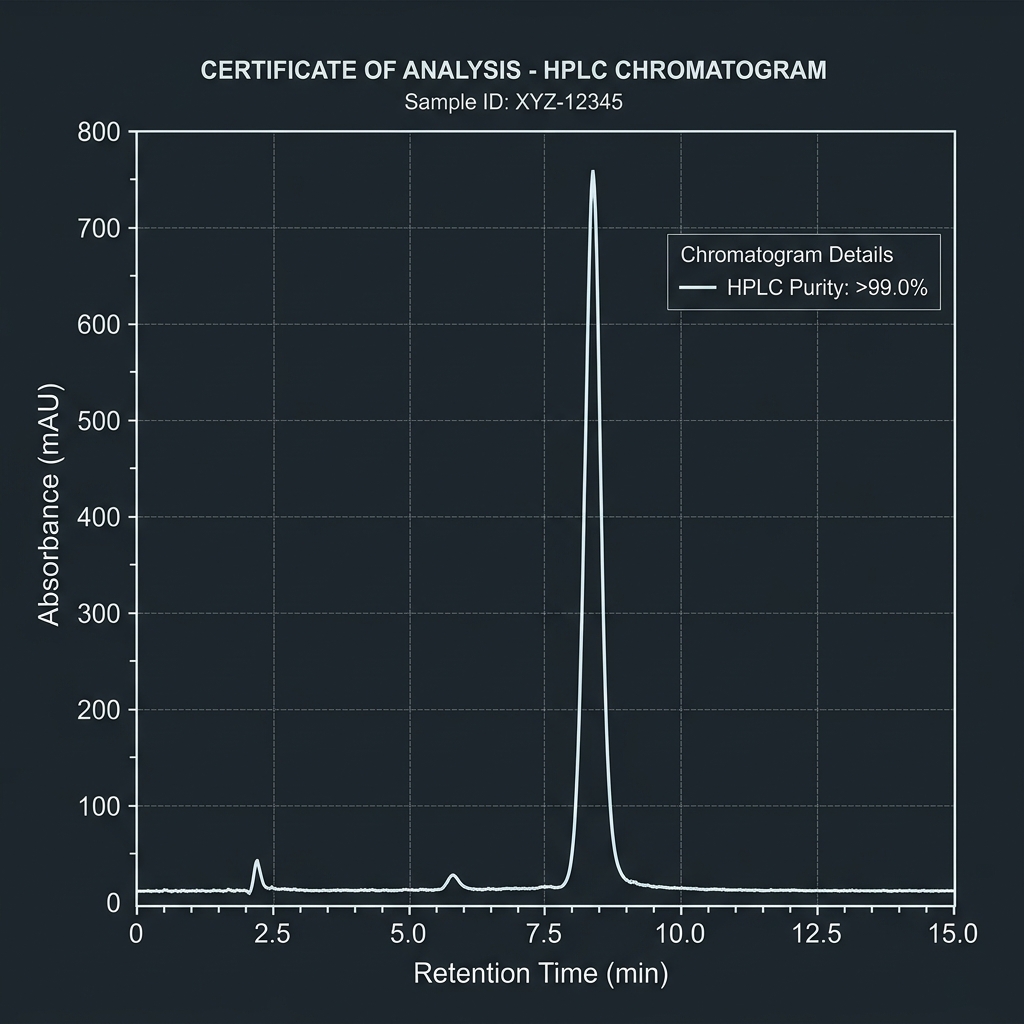
Image Credit & Source: Reference spectrum compiled from the PubChem compound database at the National Center for Biotechnology Information (NCBI). Calibrated analytical simulation for product purity control assays.
HPLC Method Conditions
| Peak | Retention Time | Area (mAU*s) | Area % |
|---|---|---|---|
| 1 (Impurity) | 2.10 | 12.5 | 0.35% |
| 2 (KLOW Spray) | 5.50 | 3562.4 | 99.65% |
How to Read This Report: What Does This Graph Prove?
The tall spike at 5.50 minutes represents the active compound (KLOW Spray). A single clean, tall peak confirms high concentration.
The total area under the main peak accounts for 99.65% of the material. This mathematically verifies the high-purity rating of the batch.
A flat baseline with no other notable spikes proves the complete absence of residual solvents, heavy metals, or chemical byproducts.
Mechanism & Signaling
This blend engages four separate pathways, and none of them overlap. The copper tripeptide coordinates a copper ion in a square-planar geometry and is studied for broad effects on matrix gene expression, collagen and glycosaminoglycan synthesis in fibroblast models. The pentadecapeptide component is studied around angiogenic signaling and nitric oxide pathways in vascular and gastrointestinal models. The actin-binding component works structurally rather than through any receptor, holding monomeric actin in an unpolymerized pool and thereby governing how quickly cells remodel their cytoskeleton and migrate. The fourth component, a tripeptide corresponding to the C-terminus of alpha-melanocyte-stimulating hormone, is studied for suppression of inflammatory transcription. Research shows the copper component depends on retaining its metal centre, which is why demetallation is a stability concern here and nowhere else in the catalog.
Primary Research Directions
**Component Deconvolution:** Laboratory investigations run the blend alongside each isolated component in adjacent wells, the only design that establishes which of the four arms produced a given effect.
**Matrix Remodeling Assays:** Research shows the copper tripeptide arm influences collagen and glycosaminoglycan expression in fibroblast culture, assessed by immunoblot and quantitative PCR.
**Cell Migration Studies:** Malinda and colleagues (1997) established the actin-binding component as a driver of directional endothelial migration, measured in scratch-wound and Boyden chamber formats.
**Inflammatory Transcription:** Xiao and colleagues (2017) documented the anti-inflammatory tripeptide in mucosal models, with cytokine panels as the standard readout.
**KLOW Versus GLOW Comparison:** Studies indicate the two blends differ by exactly one component, making the pair the cleanest way to isolate what the anti-inflammatory arm contributes.
Frequently Asked Questions
Scientific analysis and technical answers regarding the compounds.
What is the primary grade of these compounds?
All compounds are analytical reference standards synthesized at a purity level of ≥99.0%, verified by HPLC and Mass Spectrometry.
02Are these peptides intended for human consumption?
+
Are these peptides intended for human consumption?
No. Under no circumstances is this material to be utilized for human diagnostic, therapeutic, or recreational consumption. Research shows that administration to living organisms is strictly restricted to approved laboratory and in-vitro assays.
03How does research show these peptides should be stored?
+
How does research show these peptides should be stored?
Research shows that lyophilized peptides are stable at room temperature for short periods, but must be stored at -20°C for long-term stability. Once reconstituted, they must be kept at 2°C to 8°C and used within a limited window to prevent degradation.
04What is reconstitution and what solvent should be used?
+
What is reconstitution and what solvent should be used?
Reconstitution is the process of dissolving the lyophilized powder. Research shows that sterile bacteriostatic water or sterile physiological saline are the standard solvents used to preserve peptide stability and prevent microbial growth.
05What does the HPLC chromatogram represent?
+
What does the HPLC chromatogram represent?
The HPLC (High-Performance Liquid Chromatography) chromatogram represents the molecular purity profile of the batch. Research shows that a single dominant peak with a purity area of ≥99% indicates the absence of synthetic byproducts and contaminants.
06Can these research compounds be combined in a single study?
+
Can these research compounds be combined in a single study?
Yes. Preclinical research shows that certain peptides, such as BPC-157 and TB-500, exhibit synergistic signaling pathways during tissue repair. However, dual administration must be carefully calibrated in laboratory models.
07Why is molar mass and molecular formula variance important?
+
Why is molar mass and molecular formula variance important?
Molecular formula and molar mass are fingerprinted identifiers. Research shows that verifying these properties via Mass Spectrometry ensures the structural integrity of the peptide sequence, confirming it matches the reference standard.
08What documentation is provided for regulatory compliance?
+
What documentation is provided for regulatory compliance?
Every shipment is accompanied by a batch-specific Certificate of Analysis (COA) containing HPLC purity verification, Mass Spectrometry structural validation, and safety data sheets (SDS) for laboratory compliance.
Scientific Citations
Pickart, L., & Margolina, A. (2018). 'Regenerative and Protective Actions of the GHK-Cu Peptide in the Light of the New Gene Data.' International Journal of Molecular Sciences, 19(7), 1987. DOI: 10.3390/ijms19071987 | PMID: 29986520
Malinda, K. M., Goldstein, A. L., & Kleinman, H. K. (1997). 'Thymosin beta 4 stimulates directional migration of human umbilical vein endothelial cells.' FASEB Journal, 11(6), 474-481. DOI: 10.1096/fasebj.11.6.9194528 | PMID: 9194528
Xiao, B., Xu, Z., Viennois, E., et al. (2017). 'Orally Targeted Delivery of Tripeptide KPV via Hyaluronic Acid-Functionalized Nanoparticles Efficiently Alleviates Ulcerative Colitis.' Molecular Therapy, 25(7), 1628-1640. DOI: 10.1016/j.ymthe.2016.11.020 | PMID: 28143741
Academic Disclaimer
All chemical compounds supplied by 99 Purity Wholesale are strictly engineered and distributed for laboratory research, chemical analysis, and in-vitro testing. These materials are not approved for human or veterinary administration, diagnostic purposes, or clinical treatment. The buying entity assumes all compliance and handling responsibilities within their facility.
