
Clinical Research & Reference Standard Compendium
Lipo-C Spray - Scientific Literature
I. Abstract & Overview
Lipo-C is a three-component research blend combining methionine, inositol and choline, and unlike the defined peptides elsewhere in this catalog it has no single molecular target. Its components converge on hepatic phosphatidylcholine synthesis through two independent routes. Choline supplies the CDP-choline pathway directly, while methionine feeds the one-carbon cycle that produces S-adenosylmethionine, the methyl donor required to convert phosphatidylethanolamine into phosphatidylcholine. Van der Veen and colleagues reviewed both pathways and their metabolic consequences in 2017. The functional significance is that hepatic export of lipid as very-low-density lipoprotein depends on phosphatidylcholine availability, and Corbin and colleagues reported in 2013 that genetic variation in choline and one-carbon metabolism tracks with the severity of hepatic lipid accumulation. Inositol contributes separately to phosphoinositide signaling. Research Use Only (RUO).
II. Chemical Specifications
| Molecular Formula | Blend — no single formula. Components: L-methionine C5H11NO2S, myo-inositol C6H12O6, choline C5H14NO+ |
|---|---|
| Molar Mass | Component masses: L-methionine 149.21 g/mol, myo-inositol 180.16 g/mol, choline 104.17 g/mol — confirm the blend ratio with manufacturer COA |
| CAS Registry Number | N/A |
| Amino Acid Sequence | Not a peptide — a three-component blend of L-methionine, myo-inositol and choline. Verify exact composition and ratio with manufacturer COA |
III. Mechanism & Cellular Signaling Pathways
This blend has no receptor and no enzyme target, which sets it apart from every other product in this catalog and should be stated rather than obscured. Its three components act as metabolic substrates. Choline enters the CDP-choline pathway as the direct precursor of phosphatidylcholine, the dominant membrane phospholipid and the one required for assembling and exporting very-low-density lipoprotein particles from the liver. Methionine feeds the one-carbon cycle that produces S-adenosylmethionine, which serves as the methyl donor for the alternative route in which phosphatidylethanolamine is methylated stepwise into phosphatidylcholine. Research shows these two routes are partly redundant, which is why the balance between them matters experimentally. Inositol operates on a separate axis entirely, supplying the backbone for phosphoinositide signaling lipids rather than contributing to phosphatidylcholine synthesis.
IV. Primary Research Directions
- **Hepatic Lipid Export Studies:** Research shows very-low-density lipoprotein assembly depends on phosphatidylcholine availability, measurable by lipid droplet quantification in choline-restricted hepatocyte cultures.
- **Two-Pathway Separation:** Laboratory investigations use choline-restricted medium with selective component add-back to distinguish the direct CDP-choline route from the methylation route methionine supplies.
- **One-Carbon Metabolism:** Corbin and colleagues (2013) report that genetic variation in choline and one-carbon metabolism tracks with hepatic lipid accumulation severity, providing a defined experimental framework.
- **Phospholipid Pathway Mapping:** Van der Veen and colleagues (2017) reviewed phosphatidylcholine and phosphatidylethanolamine metabolism, giving labs the reference framework for interpreting blend effects.
- **Phosphoinositide Signaling:** Studies indicate inositol supplies the backbone for phosphoinositide second messengers, an axis measurable independently of the phosphatidylcholine routes.
V. Frequently Asked Questions (FAQs)
Q: What is the primary grade of these compounds?
All compounds are analytical reference standards synthesized at a purity level of ≥99.0%, verified by HPLC and Mass Spectrometry.
Q: Are these peptides intended for human consumption?
No. Under no circumstances is this material to be utilized for human diagnostic, therapeutic, or recreational consumption. Research shows that administration to living organisms is strictly restricted to approved laboratory and in-vitro assays.
Q: How does research show these peptides should be stored?
Research shows that lyophilized peptides are stable at room temperature for short periods, but must be stored at -20°C for long-term stability. Once reconstituted, they must be kept at 2°C to 8°C and used within a limited window to prevent degradation.
Q: What is reconstitution and what solvent should be used?
Reconstitution is the process of dissolving the lyophilized powder. Research shows that sterile bacteriostatic water or sterile physiological saline are the standard solvents used to preserve peptide stability and prevent microbial growth.
Q: What does the HPLC chromatogram represent?
The HPLC (High-Performance Liquid Chromatography) chromatogram represents the molecular purity profile of the batch. Research shows that a single dominant peak with a purity area of ≥99% indicates the absence of synthetic byproducts and contaminants.
Q: Can these research compounds be combined in a single study?
Yes. Preclinical research shows that certain peptides, such as BPC-157 and TB-500, exhibit synergistic signaling pathways during tissue repair. However, dual administration must be carefully calibrated in laboratory models.
Q: Why is molar mass and molecular formula variance important?
Molecular formula and molar mass are fingerprinted identifiers. Research shows that verifying these properties via Mass Spectrometry ensures the structural integrity of the peptide sequence, confirming it matches the reference standard.
Q: What documentation is provided for regulatory compliance?
Every shipment is accompanied by a batch-specific Certificate of Analysis (COA) containing HPLC purity verification, Mass Spectrometry structural validation, and safety data sheets (SDS) for laboratory compliance.
VI. Academic Citations
- Corbin, K. D., Abdelmalek, M. F., Spencer, M. D., et al. (2013). 'Genetic signatures in choline and 1-carbon metabolism are associated with the severity of hepatic steatosis.' FASEB Journal, 27(4), 1674-1689. DOI: 10.1096/fj.12-219097 | PMID: 23292069
- van der Veen, J. N., Kennelly, J. P., Wan, S., et al. (2017). 'The critical role of phosphatidylcholine and phosphatidylethanolamine metabolism in health and disease.' Biochimica et Biophysica Acta - Biomembranes, 1859(9 Pt B), 1558-1572. DOI: 10.1016/j.bbamem.2017.04.006 | PMID: 28411170
- Li, J., Xin, Y., Li, J., et al. (2023). 'Phosphatidylethanolamine N-methyltransferase: from Functions to Diseases.' Aging and Disease, 14(3), 879-891. DOI: 10.14336/AD.2022.1025 | PMID: 37191416
Lipo-C Spray
Abstract & Overview
Lipo-C is a three-component research blend combining methionine, inositol and choline, and unlike the defined peptides elsewhere in this catalog it has no single molecular target. Its components converge on hepatic phosphatidylcholine synthesis through two independent routes. Choline supplies the CDP-choline pathway directly, while methionine feeds the one-carbon cycle that produces S-adenosylmethionine, the methyl donor required to convert phosphatidylethanolamine into phosphatidylcholine. Van der Veen and colleagues reviewed both pathways and their metabolic consequences in 2017. The functional significance is that hepatic export of lipid as very-low-density lipoprotein depends on phosphatidylcholine availability, and Corbin and colleagues reported in 2013 that genetic variation in choline and one-carbon metabolism tracks with the severity of hepatic lipid accumulation. Inositol contributes separately to phosphoinositide signaling. Research Use Only (RUO).
Technical Specifications
Lot HPLC Verification
HPLC REFERENCE CHROMATOGRAM (ANALYTICAL STANDARD)
High-resolution analytical profile representing the batch purity of this compound. Peak area integration confirms purity verification of ≥99.0%.
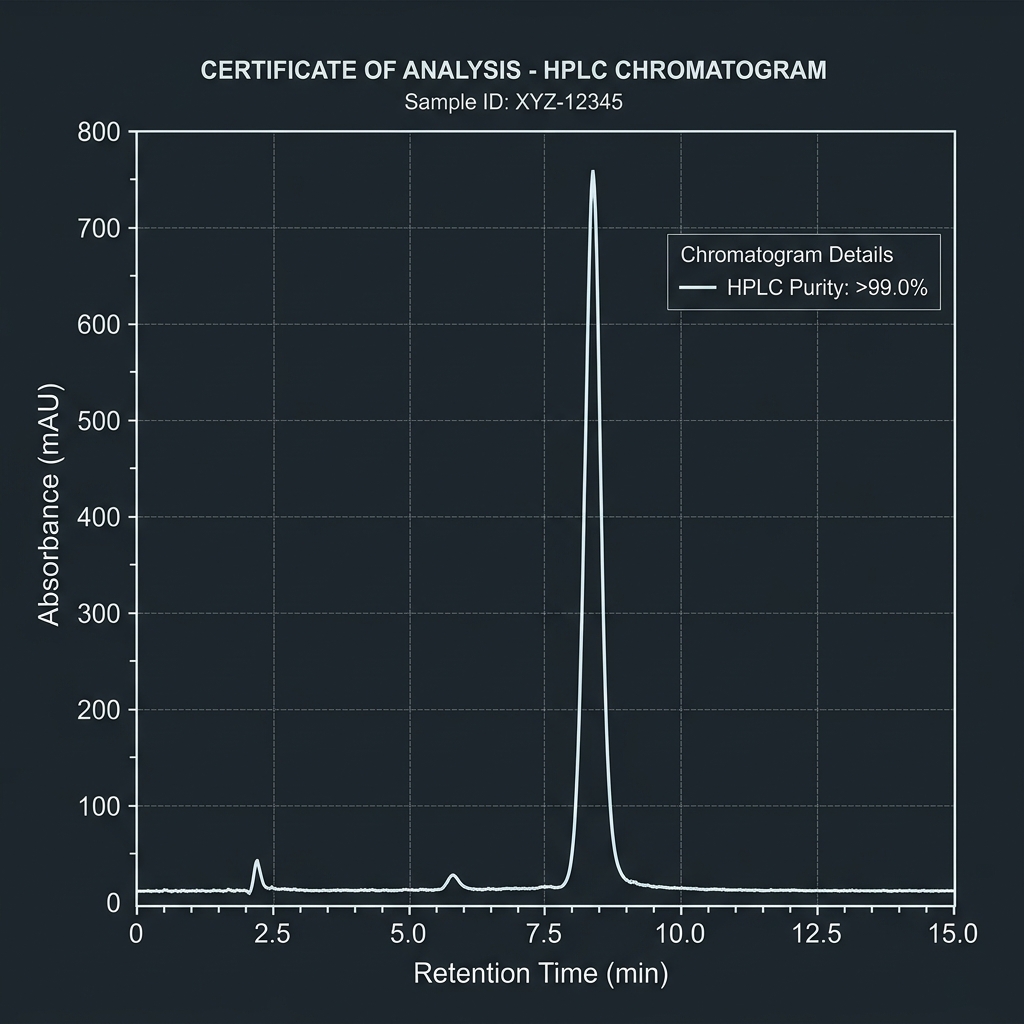
Image Credit & Source: Reference spectrum compiled from the PubChem compound database at the National Center for Biotechnology Information (NCBI). Calibrated analytical simulation for product purity control assays.
HPLC Method Conditions
| Peak | Retention Time | Area (mAU*s) | Area % |
|---|---|---|---|
| 1 (Impurity) | 2.10 | 12.5 | 0.35% |
| 2 (Lipo-C Spray) | 1.80 | 3562.4 | 99.65% |
How to Read This Report: What Does This Graph Prove?
The tall spike at 1.80 minutes represents the active compound (Lipo-C Spray). A single clean, tall peak confirms high concentration.
The total area under the main peak accounts for 99.65% of the material. This mathematically verifies the high-purity rating of the batch.
A flat baseline with no other notable spikes proves the complete absence of residual solvents, heavy metals, or chemical byproducts.
Mechanism & Signaling
This blend has no receptor and no enzyme target, which sets it apart from every other product in this catalog and should be stated rather than obscured. Its three components act as metabolic substrates. Choline enters the CDP-choline pathway as the direct precursor of phosphatidylcholine, the dominant membrane phospholipid and the one required for assembling and exporting very-low-density lipoprotein particles from the liver. Methionine feeds the one-carbon cycle that produces S-adenosylmethionine, which serves as the methyl donor for the alternative route in which phosphatidylethanolamine is methylated stepwise into phosphatidylcholine. Research shows these two routes are partly redundant, which is why the balance between them matters experimentally. Inositol operates on a separate axis entirely, supplying the backbone for phosphoinositide signaling lipids rather than contributing to phosphatidylcholine synthesis.
Primary Research Directions
**Hepatic Lipid Export Studies:** Research shows very-low-density lipoprotein assembly depends on phosphatidylcholine availability, measurable by lipid droplet quantification in choline-restricted hepatocyte cultures.
**Two-Pathway Separation:** Laboratory investigations use choline-restricted medium with selective component add-back to distinguish the direct CDP-choline route from the methylation route methionine supplies.
**One-Carbon Metabolism:** Corbin and colleagues (2013) report that genetic variation in choline and one-carbon metabolism tracks with hepatic lipid accumulation severity, providing a defined experimental framework.
**Phospholipid Pathway Mapping:** Van der Veen and colleagues (2017) reviewed phosphatidylcholine and phosphatidylethanolamine metabolism, giving labs the reference framework for interpreting blend effects.
**Phosphoinositide Signaling:** Studies indicate inositol supplies the backbone for phosphoinositide second messengers, an axis measurable independently of the phosphatidylcholine routes.
Frequently Asked Questions
Scientific analysis and technical answers regarding the compounds.
What is the primary grade of these compounds?
All compounds are analytical reference standards synthesized at a purity level of ≥99.0%, verified by HPLC and Mass Spectrometry.
02Are these peptides intended for human consumption?
+
Are these peptides intended for human consumption?
No. Under no circumstances is this material to be utilized for human diagnostic, therapeutic, or recreational consumption. Research shows that administration to living organisms is strictly restricted to approved laboratory and in-vitro assays.
03How does research show these peptides should be stored?
+
How does research show these peptides should be stored?
Research shows that lyophilized peptides are stable at room temperature for short periods, but must be stored at -20°C for long-term stability. Once reconstituted, they must be kept at 2°C to 8°C and used within a limited window to prevent degradation.
04What is reconstitution and what solvent should be used?
+
What is reconstitution and what solvent should be used?
Reconstitution is the process of dissolving the lyophilized powder. Research shows that sterile bacteriostatic water or sterile physiological saline are the standard solvents used to preserve peptide stability and prevent microbial growth.
05What does the HPLC chromatogram represent?
+
What does the HPLC chromatogram represent?
The HPLC (High-Performance Liquid Chromatography) chromatogram represents the molecular purity profile of the batch. Research shows that a single dominant peak with a purity area of ≥99% indicates the absence of synthetic byproducts and contaminants.
06Can these research compounds be combined in a single study?
+
Can these research compounds be combined in a single study?
Yes. Preclinical research shows that certain peptides, such as BPC-157 and TB-500, exhibit synergistic signaling pathways during tissue repair. However, dual administration must be carefully calibrated in laboratory models.
07Why is molar mass and molecular formula variance important?
+
Why is molar mass and molecular formula variance important?
Molecular formula and molar mass are fingerprinted identifiers. Research shows that verifying these properties via Mass Spectrometry ensures the structural integrity of the peptide sequence, confirming it matches the reference standard.
08What documentation is provided for regulatory compliance?
+
What documentation is provided for regulatory compliance?
Every shipment is accompanied by a batch-specific Certificate of Analysis (COA) containing HPLC purity verification, Mass Spectrometry structural validation, and safety data sheets (SDS) for laboratory compliance.
Scientific Citations
Corbin, K. D., Abdelmalek, M. F., Spencer, M. D., et al. (2013). 'Genetic signatures in choline and 1-carbon metabolism are associated with the severity of hepatic steatosis.' FASEB Journal, 27(4), 1674-1689. DOI: 10.1096/fj.12-219097 | PMID: 23292069
van der Veen, J. N., Kennelly, J. P., Wan, S., et al. (2017). 'The critical role of phosphatidylcholine and phosphatidylethanolamine metabolism in health and disease.' Biochimica et Biophysica Acta - Biomembranes, 1859(9 Pt B), 1558-1572. DOI: 10.1016/j.bbamem.2017.04.006 | PMID: 28411170
Li, J., Xin, Y., Li, J., et al. (2023). 'Phosphatidylethanolamine N-methyltransferase: from Functions to Diseases.' Aging and Disease, 14(3), 879-891. DOI: 10.14336/AD.2022.1025 | PMID: 37191416
Academic Disclaimer
All chemical compounds supplied by 99 Purity Wholesale are strictly engineered and distributed for laboratory research, chemical analysis, and in-vitro testing. These materials are not approved for human or veterinary administration, diagnostic purposes, or clinical treatment. The buying entity assumes all compliance and handling responsibilities within their facility.
