
Clinical Research & Reference Standard Compendium
MOTS-c Spray - Scientific Literature
I. Abstract & Overview
MOTS-c is a 16-amino-acid peptide encoded within the mitochondrial genome rather than nuclear DNA, placing it among a small group of mitochondrial-derived peptides. Lee and colleagues described it in 2015, reporting that it targets the folate and methionine cycle and that the resulting accumulation of the intermediate AICAR activates AMP-activated protein kinase, shifting cellular metabolism toward glucose utilization. Kim and colleagues subsequently reported a distinct second function: under metabolic stress the peptide translocates to the nucleus and participates in regulating antioxidant and metabolic gene expression. Reynolds and colleagues later characterized it as exercise-responsive and connected to age-dependent physical decline and muscle homeostasis. Acting in both the cytosol and the nucleus is uncommon for a peptide of this size. Research Use Only (RUO).
II. Chemical Specifications
| Molecular Formula | C101H152N28O22S2 |
|---|---|
| Molar Mass | 2174.6 g/mol (PubChem CID 146675088) |
| CAS Registry Number | 1627580-64-6 |
| Amino Acid Sequence | Met-Arg-Trp-Gln-Glu-Met-Gly-Tyr-Ile-Phe-Tyr-Pro-Arg-Lys-Leu-Arg (16 residues; two methionines; encoded in mitochondrial DNA) |
III. Mechanism & Cellular Signaling Pathways
MOTS-c operates through metabolic interference rather than receptor binding. Research shows it acts on the folate and methionine one-carbon cycle, and the practical consequence is accumulation of the purine biosynthesis intermediate AICAR. Because AICAR is a well-established activator of AMP-activated protein kinase, this indirect route converges on the same energy-sensing hub that exercise and metabolic stress engage, shifting cells toward glucose uptake and away from lipid storage. That is one mechanism. The second is transcriptional and physically separate: Kim and colleagues reported that metabolic stress drives the peptide into the nucleus, where it associates with stress-responsive transcription factors and regulates antioxidant response and metabolic gene programs. This dual cytosolic and nuclear activity distinguishes MOTS-c from SS-31, which acts purely on mitochondrial membrane lipids and never enters the nucleus.
IV. Primary Research Directions
- **AMPK Activation:** Lee and colleagues (2015) report AMP-activated protein kinase activation via the folate and methionine cycle, measured by phospho-AMPK immunoblot in myotube and hepatocyte cultures.
- **Glucose Utilization Assays:** Research shows increased glucose uptake in skeletal muscle cell models, quantified by labelled glucose uptake alongside insulin sensitivity readouts.
- **Nuclear Translocation Studies:** Kim and colleagues (2018) describe stress-induced movement of the peptide into the nucleus, traceable by subcellular fractionation and immunofluorescence imaging.
- **Exercise Response Biology:** Reynolds and colleagues (2021) report the peptide is exercise-induced and regulates muscle homeostasis, studied using treadmill and wheel-running protocols in mice.
- **Mitochondrial-Derived Peptide Comparison:** Studies indicate distinct behaviour from SS-31, which binds membrane lipids and never enters the nucleus, allowing the two mitochondrial mechanisms to be separated experimentally.
V. Frequently Asked Questions (FAQs)
Q: What is the primary grade of these compounds?
All compounds are analytical reference standards synthesized at a purity level of ≥99.0%, verified by HPLC and Mass Spectrometry.
Q: Are these peptides intended for human consumption?
No. Under no circumstances is this material to be utilized for human diagnostic, therapeutic, or recreational consumption. Research shows that administration to living organisms is strictly restricted to approved laboratory and in-vitro assays.
Q: How does research show these peptides should be stored?
Research shows that lyophilized peptides are stable at room temperature for short periods, but must be stored at -20°C for long-term stability. Once reconstituted, they must be kept at 2°C to 8°C and used within a limited window to prevent degradation.
Q: What is reconstitution and what solvent should be used?
Reconstitution is the process of dissolving the lyophilized powder. Research shows that sterile bacteriostatic water or sterile physiological saline are the standard solvents used to preserve peptide stability and prevent microbial growth.
Q: What does the HPLC chromatogram represent?
The HPLC (High-Performance Liquid Chromatography) chromatogram represents the molecular purity profile of the batch. Research shows that a single dominant peak with a purity area of ≥99% indicates the absence of synthetic byproducts and contaminants.
Q: Can these research compounds be combined in a single study?
Yes. Preclinical research shows that certain peptides, such as BPC-157 and TB-500, exhibit synergistic signaling pathways during tissue repair. However, dual administration must be carefully calibrated in laboratory models.
Q: Why is molar mass and molecular formula variance important?
Molecular formula and molar mass are fingerprinted identifiers. Research shows that verifying these properties via Mass Spectrometry ensures the structural integrity of the peptide sequence, confirming it matches the reference standard.
Q: What documentation is provided for regulatory compliance?
Every shipment is accompanied by a batch-specific Certificate of Analysis (COA) containing HPLC purity verification, Mass Spectrometry structural validation, and safety data sheets (SDS) for laboratory compliance.
VI. Academic Citations
- Lee, C., Zeng, J., Drew, B. G., et al. (2015). 'The mitochondrial-derived peptide MOTS-c promotes metabolic homeostasis and reduces obesity and insulin resistance.' Cell Metabolism, 21(3), 443-454. DOI: 10.1016/j.cmet.2015.02.009 | PMID: 25738459
- Kim, K. H., Son, J. M., Benayoun, B. A., et al. (2018). 'The Mitochondrial-Encoded Peptide MOTS-c Translocates to the Nucleus to Regulate Nuclear Gene Expression in Response to Metabolic Stress.' Cell Metabolism, 28(3), 516-524.e7. DOI: 10.1016/j.cmet.2018.06.008 | PMID: 29983246
- Reynolds, J. C., Lai, R. W., Woodhead, J. S. T., et al. (2021). 'MOTS-c is an exercise-induced mitochondrial-encoded regulator of age-dependent physical decline and muscle homeostasis.' Nature Communications, 12(1), 470. DOI: 10.1038/s41467-020-20790-0 | PMID: 33473109
MOTS-c Spray
Abstract & Overview
MOTS-c is a 16-amino-acid peptide encoded within the mitochondrial genome rather than nuclear DNA, placing it among a small group of mitochondrial-derived peptides. Lee and colleagues described it in 2015, reporting that it targets the folate and methionine cycle and that the resulting accumulation of the intermediate AICAR activates AMP-activated protein kinase, shifting cellular metabolism toward glucose utilization. Kim and colleagues subsequently reported a distinct second function: under metabolic stress the peptide translocates to the nucleus and participates in regulating antioxidant and metabolic gene expression. Reynolds and colleagues later characterized it as exercise-responsive and connected to age-dependent physical decline and muscle homeostasis. Acting in both the cytosol and the nucleus is uncommon for a peptide of this size. Research Use Only (RUO).
Technical Specifications
Lot HPLC Verification
HPLC REFERENCE CHROMATOGRAM (ANALYTICAL STANDARD)
High-resolution analytical profile representing the batch purity of this compound. Peak area integration confirms purity verification of ≥99.0%.
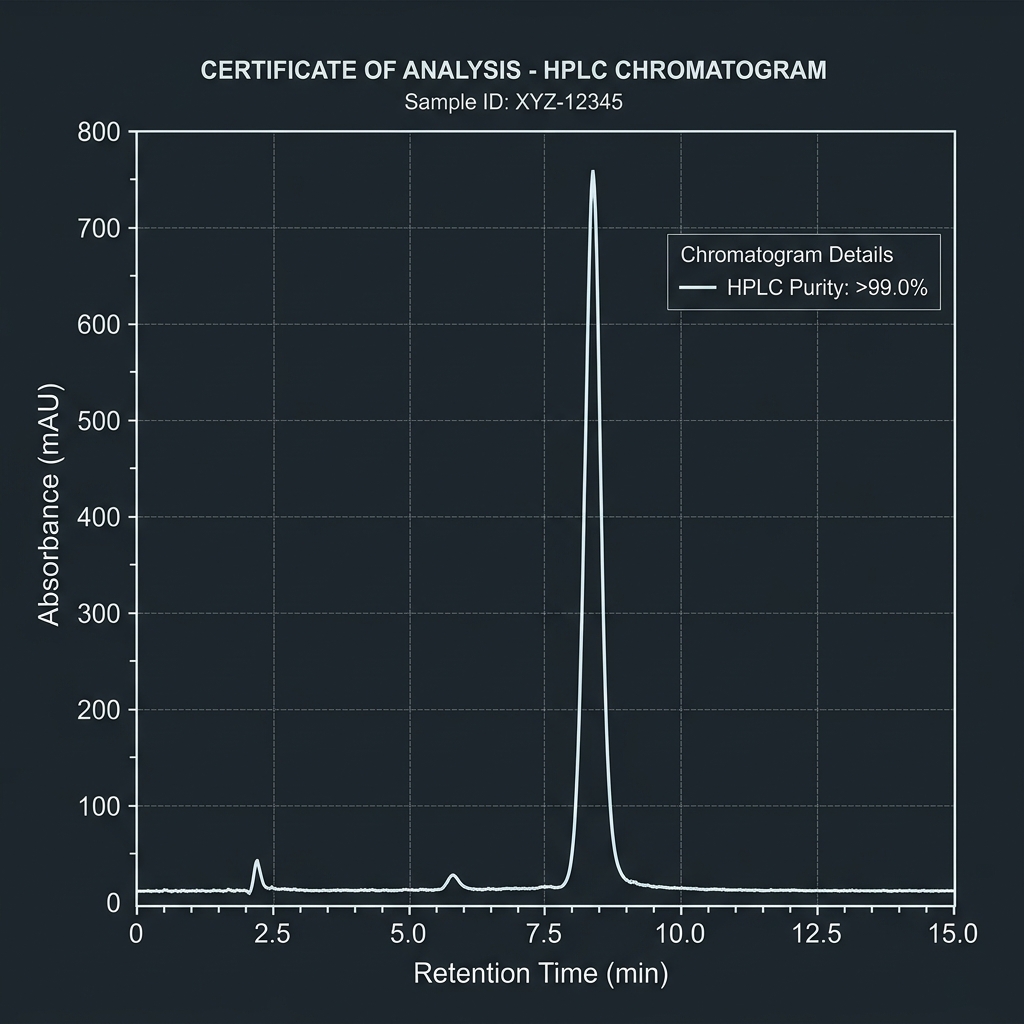
Image Credit & Source: Reference spectrum compiled from the PubChem compound database at the National Center for Biotechnology Information (NCBI). Calibrated analytical simulation for product purity control assays.
HPLC Method Conditions
| Peak | Retention Time | Area (mAU*s) | Area % |
|---|---|---|---|
| 1 (Impurity) | 2.10 | 12.5 | 0.35% |
| 2 (MOTS-c Spray) | 6.70 | 3562.4 | 99.65% |
How to Read This Report: What Does This Graph Prove?
The tall spike at 6.70 minutes represents the active compound (MOTS-c Spray). A single clean, tall peak confirms high concentration.
The total area under the main peak accounts for 99.65% of the material. This mathematically verifies the high-purity rating of the batch.
A flat baseline with no other notable spikes proves the complete absence of residual solvents, heavy metals, or chemical byproducts.
Mechanism & Signaling
MOTS-c operates through metabolic interference rather than receptor binding. Research shows it acts on the folate and methionine one-carbon cycle, and the practical consequence is accumulation of the purine biosynthesis intermediate AICAR. Because AICAR is a well-established activator of AMP-activated protein kinase, this indirect route converges on the same energy-sensing hub that exercise and metabolic stress engage, shifting cells toward glucose uptake and away from lipid storage. That is one mechanism. The second is transcriptional and physically separate: Kim and colleagues reported that metabolic stress drives the peptide into the nucleus, where it associates with stress-responsive transcription factors and regulates antioxidant response and metabolic gene programs. This dual cytosolic and nuclear activity distinguishes MOTS-c from SS-31, which acts purely on mitochondrial membrane lipids and never enters the nucleus.
Primary Research Directions
**AMPK Activation:** Lee and colleagues (2015) report AMP-activated protein kinase activation via the folate and methionine cycle, measured by phospho-AMPK immunoblot in myotube and hepatocyte cultures.
**Glucose Utilization Assays:** Research shows increased glucose uptake in skeletal muscle cell models, quantified by labelled glucose uptake alongside insulin sensitivity readouts.
**Nuclear Translocation Studies:** Kim and colleagues (2018) describe stress-induced movement of the peptide into the nucleus, traceable by subcellular fractionation and immunofluorescence imaging.
**Exercise Response Biology:** Reynolds and colleagues (2021) report the peptide is exercise-induced and regulates muscle homeostasis, studied using treadmill and wheel-running protocols in mice.
**Mitochondrial-Derived Peptide Comparison:** Studies indicate distinct behaviour from SS-31, which binds membrane lipids and never enters the nucleus, allowing the two mitochondrial mechanisms to be separated experimentally.
Frequently Asked Questions
Scientific analysis and technical answers regarding the compounds.
What is the primary grade of these compounds?
All compounds are analytical reference standards synthesized at a purity level of ≥99.0%, verified by HPLC and Mass Spectrometry.
02Are these peptides intended for human consumption?
+
Are these peptides intended for human consumption?
No. Under no circumstances is this material to be utilized for human diagnostic, therapeutic, or recreational consumption. Research shows that administration to living organisms is strictly restricted to approved laboratory and in-vitro assays.
03How does research show these peptides should be stored?
+
How does research show these peptides should be stored?
Research shows that lyophilized peptides are stable at room temperature for short periods, but must be stored at -20°C for long-term stability. Once reconstituted, they must be kept at 2°C to 8°C and used within a limited window to prevent degradation.
04What is reconstitution and what solvent should be used?
+
What is reconstitution and what solvent should be used?
Reconstitution is the process of dissolving the lyophilized powder. Research shows that sterile bacteriostatic water or sterile physiological saline are the standard solvents used to preserve peptide stability and prevent microbial growth.
05What does the HPLC chromatogram represent?
+
What does the HPLC chromatogram represent?
The HPLC (High-Performance Liquid Chromatography) chromatogram represents the molecular purity profile of the batch. Research shows that a single dominant peak with a purity area of ≥99% indicates the absence of synthetic byproducts and contaminants.
06Can these research compounds be combined in a single study?
+
Can these research compounds be combined in a single study?
Yes. Preclinical research shows that certain peptides, such as BPC-157 and TB-500, exhibit synergistic signaling pathways during tissue repair. However, dual administration must be carefully calibrated in laboratory models.
07Why is molar mass and molecular formula variance important?
+
Why is molar mass and molecular formula variance important?
Molecular formula and molar mass are fingerprinted identifiers. Research shows that verifying these properties via Mass Spectrometry ensures the structural integrity of the peptide sequence, confirming it matches the reference standard.
08What documentation is provided for regulatory compliance?
+
What documentation is provided for regulatory compliance?
Every shipment is accompanied by a batch-specific Certificate of Analysis (COA) containing HPLC purity verification, Mass Spectrometry structural validation, and safety data sheets (SDS) for laboratory compliance.
Scientific Citations
Lee, C., Zeng, J., Drew, B. G., et al. (2015). 'The mitochondrial-derived peptide MOTS-c promotes metabolic homeostasis and reduces obesity and insulin resistance.' Cell Metabolism, 21(3), 443-454. DOI: 10.1016/j.cmet.2015.02.009 | PMID: 25738459
Kim, K. H., Son, J. M., Benayoun, B. A., et al. (2018). 'The Mitochondrial-Encoded Peptide MOTS-c Translocates to the Nucleus to Regulate Nuclear Gene Expression in Response to Metabolic Stress.' Cell Metabolism, 28(3), 516-524.e7. DOI: 10.1016/j.cmet.2018.06.008 | PMID: 29983246
Reynolds, J. C., Lai, R. W., Woodhead, J. S. T., et al. (2021). 'MOTS-c is an exercise-induced mitochondrial-encoded regulator of age-dependent physical decline and muscle homeostasis.' Nature Communications, 12(1), 470. DOI: 10.1038/s41467-020-20790-0 | PMID: 33473109
Academic Disclaimer
All chemical compounds supplied by 99 Purity Wholesale are strictly engineered and distributed for laboratory research, chemical analysis, and in-vitro testing. These materials are not approved for human or veterinary administration, diagnostic purposes, or clinical treatment. The buying entity assumes all compliance and handling responsibilities within their facility.
