
Clinical Research & Reference Standard Compendium
Retatrutide Spray - Scientific Literature
I. Abstract & Overview
Retatrutide is a synthetic 39-amino-acid peptide engineered as a single molecule that activates three receptors: the GLP-1 receptor, the GIP receptor, and the glucagon receptor. Coskun and colleagues first described it in 2022, reporting that the in-vitro potency ranking is led by the GIP receptor with balanced but lower activity at the GLP-1 and glucagon receptors. Like Tirzepatide, its backbone derives from GIP rather than GLP-1, and a fatty diacid conjugation drives albumin binding and extended circulating residence. The glucagon receptor arm is the defining addition, contributing an energy-expenditure and hepatic lipid component absent from single and dual agonists. A 2023 follow-up reported that gastric emptying is delayed and that the effect attenuates over repeated exposure. Research Use Only (RUO).
II. Chemical Specifications
| Molecular Formula | C221H342N46O68 — verify with manufacturer COA (no PubChem CID currently indexed for retatrutide) |
|---|---|
| Molar Mass | Approximately 4731 g/mol — verify with manufacturer COA; not independently confirmable against PubChem at this time |
| CAS Registry Number | 2381089-83-2 |
| Amino Acid Sequence | 39-amino-acid synthetic peptide, C-terminally amidated, built on a GIP-derived backbone with two aminoisobutyric acid substitutions and a fatty diacid conjugation — verify exact sequence and conjugation site with manufacturer COA |
III. Mechanism & Cellular Signaling Pathways
Retatrutide activates three class B G protein-coupled receptors from a single peptide chain. Each couples to adenylyl cyclase, raising cAMP and engaging protein kinase A, but the downstream consequences diverge by tissue. In pancreatic beta cells, the GLP-1 and GIP arms converge on glucose-dependent insulin granule exocytosis. In hepatocytes, the glucagon arm engages a pathway the incretin receptors do not touch, influencing hepatic glucose output, lipid handling, and energy expenditure. Research shows this is what separates Retatrutide from its predecessors: Semaglutide engages the GLP-1 receptor alone, Tirzepatide adds the GIP receptor, and only Retatrutide recruits the glucagon receptor as well. Balancing the three activities was the central design problem, since unopposed glucagon receptor signaling opposes the glucose-lowering effect of the incretin arms. The fatty diacid contributes no receptor contact and serves albumin binding.
IV. Primary Research Directions
- **Triple Receptor Pharmacology:** Research shows concurrent activation of the GLP-1, GIP, and glucagon receptors, resolved by running three stably transfected cell lines in parallel and comparing cAMP concentration-response curves receptor by receptor.
- **Glucagon Arm Isolation:** Laboratory investigations use Retatrutide alongside Semaglutide and Tirzepatide to isolate what the glucagon receptor contributes, since it is the only tool compound in the series that engages all three.
- **Hepatic Lipid and Energy Studies:** Studies indicate effects on hepatic glucose output and lipid handling in hepatocyte models, questions that arise specifically from glucagon receptor engagement.
- **Glucose-Stimulated Insulin Secretion:** Research shows modulation of insulin release in isolated islets under static incubation and perifusion, comparing low and high glucose conditions to confirm glucose dependence.
- **Gastric Emptying Kinetics:** Urva and colleagues (2023) report delayed gastric emptying with attenuation across repeated exposure, a time-dependent profile measurable in standard gastric transit models.
V. Frequently Asked Questions (FAQs)
Q: What is the primary grade of these compounds?
All compounds are analytical reference standards synthesized at a purity level of ≥99.0%, verified by HPLC and Mass Spectrometry.
Q: Are these peptides intended for human consumption?
No. Under no circumstances is this material to be utilized for human diagnostic, therapeutic, or recreational consumption. Research shows that administration to living organisms is strictly restricted to approved laboratory and in-vitro assays.
Q: How does research show these peptides should be stored?
Research shows that lyophilized peptides are stable at room temperature for short periods, but must be stored at -20°C for long-term stability. Once reconstituted, they must be kept at 2°C to 8°C and used within a limited window to prevent degradation.
Q: What is reconstitution and what solvent should be used?
Reconstitution is the process of dissolving the lyophilized powder. Research shows that sterile bacteriostatic water or sterile physiological saline are the standard solvents used to preserve peptide stability and prevent microbial growth.
Q: What does the HPLC chromatogram represent?
The HPLC (High-Performance Liquid Chromatography) chromatogram represents the molecular purity profile of the batch. Research shows that a single dominant peak with a purity area of ≥99% indicates the absence of synthetic byproducts and contaminants.
Q: Can these research compounds be combined in a single study?
Yes. Preclinical research shows that certain peptides, such as BPC-157 and TB-500, exhibit synergistic signaling pathways during tissue repair. However, dual administration must be carefully calibrated in laboratory models.
Q: Why is molar mass and molecular formula variance important?
Molecular formula and molar mass are fingerprinted identifiers. Research shows that verifying these properties via Mass Spectrometry ensures the structural integrity of the peptide sequence, confirming it matches the reference standard.
Q: What documentation is provided for regulatory compliance?
Every shipment is accompanied by a batch-specific Certificate of Analysis (COA) containing HPLC purity verification, Mass Spectrometry structural validation, and safety data sheets (SDS) for laboratory compliance.
VI. Academic Citations
- Coskun, T., Urva, S., Roell, W. C., et al. (2022). 'LY3437943, a novel triple glucagon, GIP, and GLP-1 receptor agonist for glycemic control and weight loss: From discovery to clinical proof of concept.' Cell Metabolism, 34(9), 1234-1247.e9. DOI: 10.1016/j.cmet.2022.07.013 | PMID: 35985340
- Urva, S., Coskun, T., Loh, M. T., et al. (2022). 'LY3437943, a novel triple GIP, GLP-1, and glucagon receptor agonist: a phase 1b, multicentre, double-blind, placebo-controlled, randomised, multiple-ascending dose trial.' The Lancet, 400(10366), 1869-1881. DOI: 10.1016/S0140-6736(22)02033-5 | PMID: 36354040
- Urva, S., O'Farrell, L., Du, Y., et al. (2023). 'The novel GIP, GLP-1 and glucagon receptor agonist retatrutide delays gastric emptying.' Diabetes, Obesity and Metabolism, 25(9), 2784-2788. DOI: 10.1111/dom.15167 | PMID: 37311727
Retatrutide Spray
Abstract & Overview
Retatrutide is a synthetic 39-amino-acid peptide engineered as a single molecule that activates three receptors: the GLP-1 receptor, the GIP receptor, and the glucagon receptor. Coskun and colleagues first described it in 2022, reporting that the in-vitro potency ranking is led by the GIP receptor with balanced but lower activity at the GLP-1 and glucagon receptors. Like Tirzepatide, its backbone derives from GIP rather than GLP-1, and a fatty diacid conjugation drives albumin binding and extended circulating residence. The glucagon receptor arm is the defining addition, contributing an energy-expenditure and hepatic lipid component absent from single and dual agonists. A 2023 follow-up reported that gastric emptying is delayed and that the effect attenuates over repeated exposure. Research Use Only (RUO).
Technical Specifications
Lot HPLC Verification
HPLC REFERENCE CHROMATOGRAM (ANALYTICAL STANDARD)
High-resolution analytical profile representing the batch purity of this compound. Peak area integration confirms purity verification of ≥99.0%.
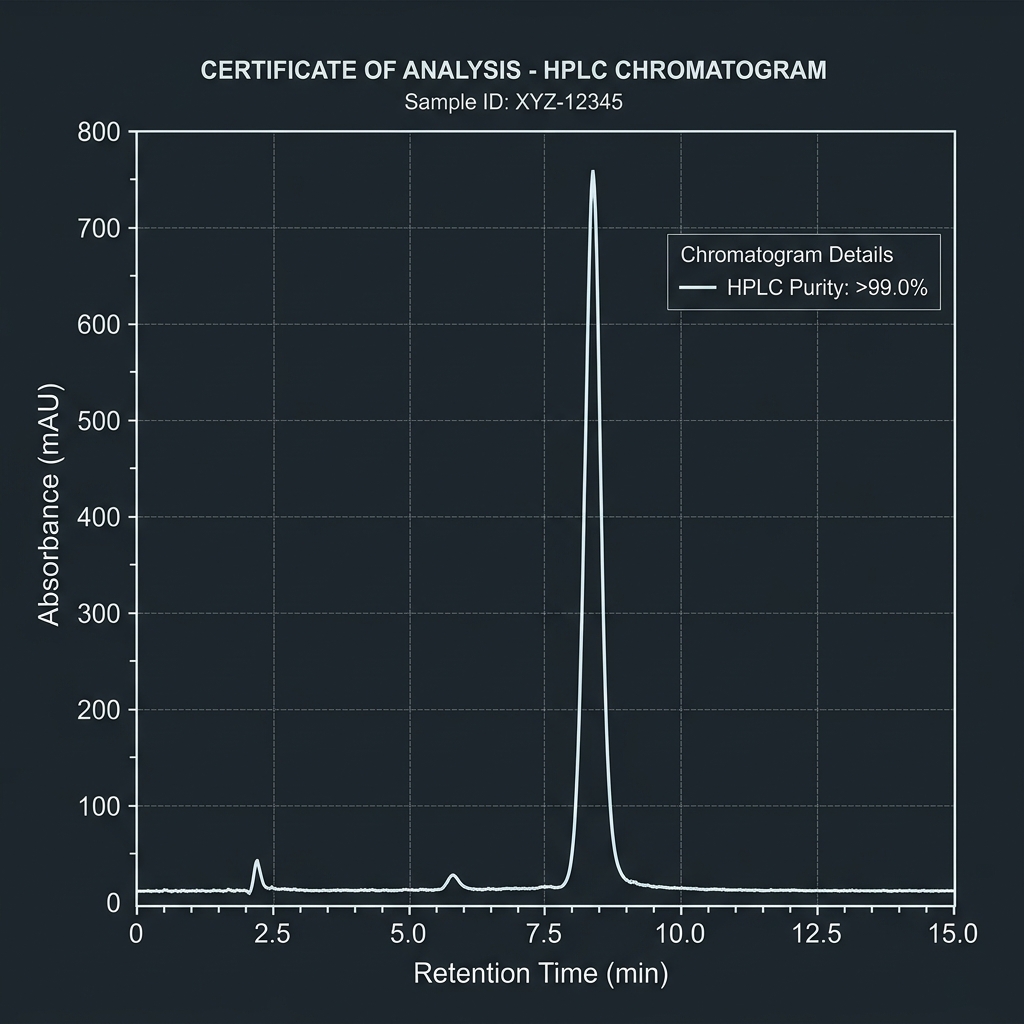
Image Credit & Source: Reference spectrum compiled from the PubChem compound database at the National Center for Biotechnology Information (NCBI). Calibrated analytical simulation for product purity control assays.
HPLC Method Conditions
| Peak | Retention Time | Area (mAU*s) | Area % |
|---|---|---|---|
| 1 (Impurity) | 2.10 | 12.5 | 0.35% |
| 2 (Retatrutide Spray) | 12.90 | 3562.4 | 99.65% |
How to Read This Report: What Does This Graph Prove?
The tall spike at 12.90 minutes represents the active compound (Retatrutide Spray). A single clean, tall peak confirms high concentration.
The total area under the main peak accounts for 99.65% of the material. This mathematically verifies the high-purity rating of the batch.
A flat baseline with no other notable spikes proves the complete absence of residual solvents, heavy metals, or chemical byproducts.
Mechanism & Signaling
Retatrutide activates three class B G protein-coupled receptors from a single peptide chain. Each couples to adenylyl cyclase, raising cAMP and engaging protein kinase A, but the downstream consequences diverge by tissue. In pancreatic beta cells, the GLP-1 and GIP arms converge on glucose-dependent insulin granule exocytosis. In hepatocytes, the glucagon arm engages a pathway the incretin receptors do not touch, influencing hepatic glucose output, lipid handling, and energy expenditure. Research shows this is what separates Retatrutide from its predecessors: Semaglutide engages the GLP-1 receptor alone, Tirzepatide adds the GIP receptor, and only Retatrutide recruits the glucagon receptor as well. Balancing the three activities was the central design problem, since unopposed glucagon receptor signaling opposes the glucose-lowering effect of the incretin arms. The fatty diacid contributes no receptor contact and serves albumin binding.
Primary Research Directions
**Triple Receptor Pharmacology:** Research shows concurrent activation of the GLP-1, GIP, and glucagon receptors, resolved by running three stably transfected cell lines in parallel and comparing cAMP concentration-response curves receptor by receptor.
**Glucagon Arm Isolation:** Laboratory investigations use Retatrutide alongside Semaglutide and Tirzepatide to isolate what the glucagon receptor contributes, since it is the only tool compound in the series that engages all three.
**Hepatic Lipid and Energy Studies:** Studies indicate effects on hepatic glucose output and lipid handling in hepatocyte models, questions that arise specifically from glucagon receptor engagement.
**Glucose-Stimulated Insulin Secretion:** Research shows modulation of insulin release in isolated islets under static incubation and perifusion, comparing low and high glucose conditions to confirm glucose dependence.
**Gastric Emptying Kinetics:** Urva and colleagues (2023) report delayed gastric emptying with attenuation across repeated exposure, a time-dependent profile measurable in standard gastric transit models.
Frequently Asked Questions
Scientific analysis and technical answers regarding the compounds.
What is the primary grade of these compounds?
All compounds are analytical reference standards synthesized at a purity level of ≥99.0%, verified by HPLC and Mass Spectrometry.
02Are these peptides intended for human consumption?
+
Are these peptides intended for human consumption?
No. Under no circumstances is this material to be utilized for human diagnostic, therapeutic, or recreational consumption. Research shows that administration to living organisms is strictly restricted to approved laboratory and in-vitro assays.
03How does research show these peptides should be stored?
+
How does research show these peptides should be stored?
Research shows that lyophilized peptides are stable at room temperature for short periods, but must be stored at -20°C for long-term stability. Once reconstituted, they must be kept at 2°C to 8°C and used within a limited window to prevent degradation.
04What is reconstitution and what solvent should be used?
+
What is reconstitution and what solvent should be used?
Reconstitution is the process of dissolving the lyophilized powder. Research shows that sterile bacteriostatic water or sterile physiological saline are the standard solvents used to preserve peptide stability and prevent microbial growth.
05What does the HPLC chromatogram represent?
+
What does the HPLC chromatogram represent?
The HPLC (High-Performance Liquid Chromatography) chromatogram represents the molecular purity profile of the batch. Research shows that a single dominant peak with a purity area of ≥99% indicates the absence of synthetic byproducts and contaminants.
06Can these research compounds be combined in a single study?
+
Can these research compounds be combined in a single study?
Yes. Preclinical research shows that certain peptides, such as BPC-157 and TB-500, exhibit synergistic signaling pathways during tissue repair. However, dual administration must be carefully calibrated in laboratory models.
07Why is molar mass and molecular formula variance important?
+
Why is molar mass and molecular formula variance important?
Molecular formula and molar mass are fingerprinted identifiers. Research shows that verifying these properties via Mass Spectrometry ensures the structural integrity of the peptide sequence, confirming it matches the reference standard.
08What documentation is provided for regulatory compliance?
+
What documentation is provided for regulatory compliance?
Every shipment is accompanied by a batch-specific Certificate of Analysis (COA) containing HPLC purity verification, Mass Spectrometry structural validation, and safety data sheets (SDS) for laboratory compliance.
Scientific Citations
Coskun, T., Urva, S., Roell, W. C., et al. (2022). 'LY3437943, a novel triple glucagon, GIP, and GLP-1 receptor agonist for glycemic control and weight loss: From discovery to clinical proof of concept.' Cell Metabolism, 34(9), 1234-1247.e9. DOI: 10.1016/j.cmet.2022.07.013 | PMID: 35985340
Urva, S., Coskun, T., Loh, M. T., et al. (2022). 'LY3437943, a novel triple GIP, GLP-1, and glucagon receptor agonist: a phase 1b, multicentre, double-blind, placebo-controlled, randomised, multiple-ascending dose trial.' The Lancet, 400(10366), 1869-1881. DOI: 10.1016/S0140-6736(22)02033-5 | PMID: 36354040
Urva, S., O'Farrell, L., Du, Y., et al. (2023). 'The novel GIP, GLP-1 and glucagon receptor agonist retatrutide delays gastric emptying.' Diabetes, Obesity and Metabolism, 25(9), 2784-2788. DOI: 10.1111/dom.15167 | PMID: 37311727
Academic Disclaimer
All chemical compounds supplied by 99 Purity Wholesale are strictly engineered and distributed for laboratory research, chemical analysis, and in-vitro testing. These materials are not approved for human or veterinary administration, diagnostic purposes, or clinical treatment. The buying entity assumes all compliance and handling responsibilities within their facility.
