
Clinical Research & Reference Standard Compendium
Semaglutide Spray - Scientific Literature
I. Abstract & Overview
Semaglutide is a synthetic 31-residue analogue of human GLP-1(7-37) developed at Novo Nordisk and first described by Lau et al. (2015), sharing 94% sequence identity with the native incretin. It acts as a selective agonist at the glucagon-like peptide-1 receptor (GLP-1R, UniProt P43220) and engages no other incretin receptor. Three deliberate modifications define it: an α-aminoisobutyric acid (Aib) substitution at position 8 that blocks dipeptidyl peptidase-4 cleavage, a Lys34→Arg swap that confines acylation to a single site, and a γGlu-2×AEEA-linked C18 octadecanedioic diacid at Lys26 that drives high-affinity albumin binding. That C18 diacid is the key departure from Liraglutide's C16 monoacid and extends circulating half-life to roughly 165 hours. Gabery et al. (2020) later mapped GLP-1R engagement across circumventricular organs. Research Use Only (RUO).
II. Chemical Specifications
| Molecular Formula | C187H291N45O59 |
|---|---|
| Molar Mass | 4113.58 g/mol (PubChem CID 56843331 lists 4114) — confirm salt/acetate content with manufacturer COA |
| CAS Registry Number | 910463-68-2 |
| Amino Acid Sequence | His-Aib-Glu-Gly-Thr-Phe-Thr-Ser-Asp-Val-Ser-Ser-Tyr-Leu-Glu-Gly-Gln-Ala-Ala-Lys(γGlu-2×AEEA-C18 diacid)-Glu-Phe-Ile-Ala-Trp-Leu-Val-Arg-Gly-Arg-Gly-OH (31 residues; Aib8, Lys26 acylation and Arg34 in GLP-1(7-37) numbering) |
III. Mechanism & Cellular Signaling Pathways
Semaglutide binds the GLP-1 receptor, a class B1 G protein-coupled receptor, through the two-domain mechanism typical of the secretin family: the peptide C-terminus docks the large extracellular domain while the N-terminal His-Aib segment inserts into the transmembrane core to trigger activation. Receptor activation couples through Gαs to adenylyl cyclase, elevating cAMP and engaging both PKA and Epac2. In beta-cell models that cascade closes ATP-sensitive potassium channels, depolarizes the membrane, opens voltage-gated Ca²⁺ channels, and drives glucose-dependent insulin granule exocytosis (KEGG hsa04911). What distinguishes Semaglutide pharmacologically is selectivity and balance. Research shows it is a full, balanced GLP-1R agonist that recruits β-arrestin robustly alongside cAMP — unlike Tirzepatide, which adds GIPR agonism and is biased away from β-arrestin, and unlike Retatrutide, which further recruits the glucagon receptor. The Lys26 lipid arm contributes no receptor contact; it binds serum albumin.
IV. Primary Research Directions
- **GLP-1 Receptor Pharmacology:** Research shows full, balanced agonism at human GLP-1R in HEK293 lines stably expressing the receptor, with cAMP accumulation quantified by HTRF or GloSensor to generate reference concentration-response curves.
- **Balanced-Agonist Reference Standard:** Laboratory investigations use Semaglutide as the unbiased comparator against which biased ligands such as Tirzepatide are scored in parallel β-arrestin BRET and cAMP assays.
- **Glucose-Stimulated Insulin Secretion:** Studies indicate modulation of insulin release in isolated murine and human islets under static incubation and perifusion, comparing 2.8 mM against 16.7 mM glucose to confirm glucose dependence.
- **Central Circuit Mapping:** Gabery et al. (2020) report GLP-1R engagement in circumventricular organs including the area postrema and subfornical organ, traced by c-Fos activation mapping across hindbrain and hypothalamic networks.
- **DPP-4 Resistance and Albumin Affinity:** Research shows the Aib8 substitution blocks DPP-4 cleavage while the C18 diacid confers reversible albumin binding, both measurable by DPP-4 enzymatic assay and surface plasmon resonance.
V. Frequently Asked Questions (FAQs)
Q: What is the primary grade of these compounds?
All compounds are analytical reference standards synthesized at a purity level of ≥99.0%, verified by HPLC and Mass Spectrometry.
Q: Are these peptides intended for human consumption?
No. Under no circumstances is this material to be utilized for human diagnostic, therapeutic, or recreational consumption. Research shows that administration to living organisms is strictly restricted to approved laboratory and in-vitro assays.
Q: How does research show these peptides should be stored?
Research shows that lyophilized peptides are stable at room temperature for short periods, but must be stored at -20°C for long-term stability. Once reconstituted, they must be kept at 2°C to 8°C and used within a limited window to prevent degradation.
Q: What is reconstitution and what solvent should be used?
Reconstitution is the process of dissolving the lyophilized powder. Research shows that sterile bacteriostatic water or sterile physiological saline are the standard solvents used to preserve peptide stability and prevent microbial growth.
Q: What does the HPLC chromatogram represent?
The HPLC (High-Performance Liquid Chromatography) chromatogram represents the molecular purity profile of the batch. Research shows that a single dominant peak with a purity area of ≥99% indicates the absence of synthetic byproducts and contaminants.
Q: Can these research compounds be combined in a single study?
Yes. Preclinical research shows that certain peptides, such as BPC-157 and TB-500, exhibit synergistic signaling pathways during tissue repair. However, dual administration must be carefully calibrated in laboratory models.
Q: Why is molar mass and molecular formula variance important?
Molecular formula and molar mass are fingerprinted identifiers. Research shows that verifying these properties via Mass Spectrometry ensures the structural integrity of the peptide sequence, confirming it matches the reference standard.
Q: What documentation is provided for regulatory compliance?
Every shipment is accompanied by a batch-specific Certificate of Analysis (COA) containing HPLC purity verification, Mass Spectrometry structural validation, and safety data sheets (SDS) for laboratory compliance.
VI. Academic Citations
- Lau, J., Bloch, P., Schäffer, L., Pettersson, I., et al. (2015). 'Discovery of the Once-Weekly Glucagon-Like Peptide-1 (GLP-1) Analogue Semaglutide.' Journal of Medicinal Chemistry, 58(18), 7370-7380. DOI: 10.1021/acs.jmedchem.5b00726 | PMID: 26308095
- Knudsen, L. B., & Lau, J. (2019). 'The Discovery and Development of Liraglutide and Semaglutide.' Frontiers in Endocrinology, 10, 155. DOI: 10.3389/fendo.2019.00155 | PMID: 31031702
- Gabery, S., Salinas, C. G., Paulsen, S. J., et al. (2020). 'Semaglutide lowers body weight in rodents via distributed neural pathways.' JCI Insight, 5(6), e133429. DOI: 10.1172/jci.insight.133429 | PMID: 32213703
Semaglutide Spray
Abstract & Overview
Semaglutide is a synthetic 31-residue analogue of human GLP-1(7-37) developed at Novo Nordisk and first described by Lau et al. (2015), sharing 94% sequence identity with the native incretin. It acts as a selective agonist at the glucagon-like peptide-1 receptor (GLP-1R, UniProt P43220) and engages no other incretin receptor. Three deliberate modifications define it: an α-aminoisobutyric acid (Aib) substitution at position 8 that blocks dipeptidyl peptidase-4 cleavage, a Lys34→Arg swap that confines acylation to a single site, and a γGlu-2×AEEA-linked C18 octadecanedioic diacid at Lys26 that drives high-affinity albumin binding. That C18 diacid is the key departure from Liraglutide's C16 monoacid and extends circulating half-life to roughly 165 hours. Gabery et al. (2020) later mapped GLP-1R engagement across circumventricular organs. Research Use Only (RUO).
Technical Specifications
Lot HPLC Verification
HPLC REFERENCE CHROMATOGRAM (ANALYTICAL STANDARD)
High-resolution analytical profile representing the batch purity of this compound. Peak area integration confirms purity verification of ≥99.0%.
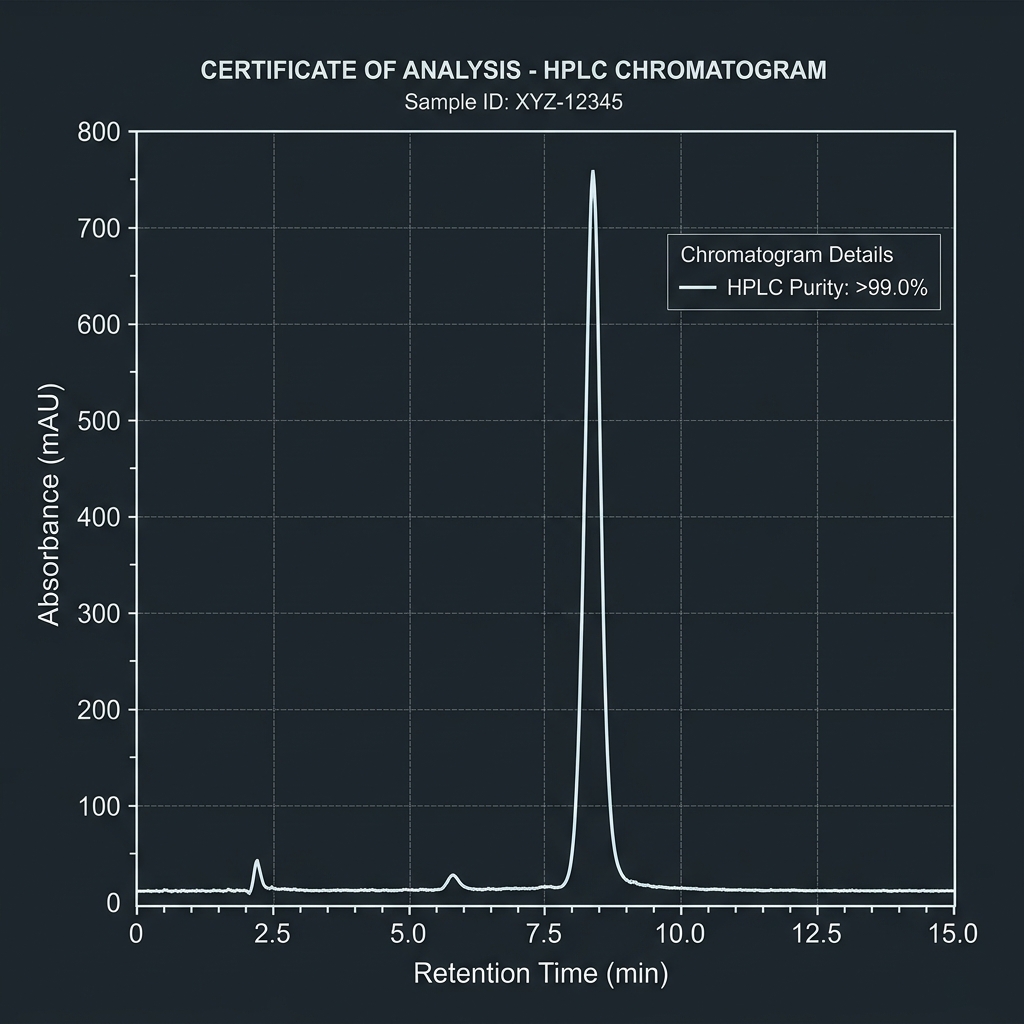
Image Credit & Source: Reference spectrum compiled from the PubChem compound database at the National Center for Biotechnology Information (NCBI). Calibrated analytical simulation for product purity control assays.
HPLC Method Conditions
| Peak | Retention Time | Area (mAU*s) | Area % |
|---|---|---|---|
| 1 (Impurity) | 2.10 | 12.5 | 0.35% |
| 2 (Semaglutide Spray) | 11.80 | 3562.4 | 99.65% |
How to Read This Report: What Does This Graph Prove?
The tall spike at 11.80 minutes represents the active compound (Semaglutide Spray). A single clean, tall peak confirms high concentration.
The total area under the main peak accounts for 99.65% of the material. This mathematically verifies the high-purity rating of the batch.
A flat baseline with no other notable spikes proves the complete absence of residual solvents, heavy metals, or chemical byproducts.
Mechanism & Signaling
Semaglutide binds the GLP-1 receptor, a class B1 G protein-coupled receptor, through the two-domain mechanism typical of the secretin family: the peptide C-terminus docks the large extracellular domain while the N-terminal His-Aib segment inserts into the transmembrane core to trigger activation. Receptor activation couples through Gαs to adenylyl cyclase, elevating cAMP and engaging both PKA and Epac2. In beta-cell models that cascade closes ATP-sensitive potassium channels, depolarizes the membrane, opens voltage-gated Ca²⁺ channels, and drives glucose-dependent insulin granule exocytosis (KEGG hsa04911). What distinguishes Semaglutide pharmacologically is selectivity and balance. Research shows it is a full, balanced GLP-1R agonist that recruits β-arrestin robustly alongside cAMP — unlike Tirzepatide, which adds GIPR agonism and is biased away from β-arrestin, and unlike Retatrutide, which further recruits the glucagon receptor. The Lys26 lipid arm contributes no receptor contact; it binds serum albumin.
Primary Research Directions
**GLP-1 Receptor Pharmacology:** Research shows full, balanced agonism at human GLP-1R in HEK293 lines stably expressing the receptor, with cAMP accumulation quantified by HTRF or GloSensor to generate reference concentration-response curves.
**Balanced-Agonist Reference Standard:** Laboratory investigations use Semaglutide as the unbiased comparator against which biased ligands such as Tirzepatide are scored in parallel β-arrestin BRET and cAMP assays.
**Glucose-Stimulated Insulin Secretion:** Studies indicate modulation of insulin release in isolated murine and human islets under static incubation and perifusion, comparing 2.8 mM against 16.7 mM glucose to confirm glucose dependence.
**Central Circuit Mapping:** Gabery et al. (2020) report GLP-1R engagement in circumventricular organs including the area postrema and subfornical organ, traced by c-Fos activation mapping across hindbrain and hypothalamic networks.
**DPP-4 Resistance and Albumin Affinity:** Research shows the Aib8 substitution blocks DPP-4 cleavage while the C18 diacid confers reversible albumin binding, both measurable by DPP-4 enzymatic assay and surface plasmon resonance.
Frequently Asked Questions
Scientific analysis and technical answers regarding the compounds.
What is the primary grade of these compounds?
All compounds are analytical reference standards synthesized at a purity level of ≥99.0%, verified by HPLC and Mass Spectrometry.
02Are these peptides intended for human consumption?
+
Are these peptides intended for human consumption?
No. Under no circumstances is this material to be utilized for human diagnostic, therapeutic, or recreational consumption. Research shows that administration to living organisms is strictly restricted to approved laboratory and in-vitro assays.
03How does research show these peptides should be stored?
+
How does research show these peptides should be stored?
Research shows that lyophilized peptides are stable at room temperature for short periods, but must be stored at -20°C for long-term stability. Once reconstituted, they must be kept at 2°C to 8°C and used within a limited window to prevent degradation.
04What is reconstitution and what solvent should be used?
+
What is reconstitution and what solvent should be used?
Reconstitution is the process of dissolving the lyophilized powder. Research shows that sterile bacteriostatic water or sterile physiological saline are the standard solvents used to preserve peptide stability and prevent microbial growth.
05What does the HPLC chromatogram represent?
+
What does the HPLC chromatogram represent?
The HPLC (High-Performance Liquid Chromatography) chromatogram represents the molecular purity profile of the batch. Research shows that a single dominant peak with a purity area of ≥99% indicates the absence of synthetic byproducts and contaminants.
06Can these research compounds be combined in a single study?
+
Can these research compounds be combined in a single study?
Yes. Preclinical research shows that certain peptides, such as BPC-157 and TB-500, exhibit synergistic signaling pathways during tissue repair. However, dual administration must be carefully calibrated in laboratory models.
07Why is molar mass and molecular formula variance important?
+
Why is molar mass and molecular formula variance important?
Molecular formula and molar mass are fingerprinted identifiers. Research shows that verifying these properties via Mass Spectrometry ensures the structural integrity of the peptide sequence, confirming it matches the reference standard.
08What documentation is provided for regulatory compliance?
+
What documentation is provided for regulatory compliance?
Every shipment is accompanied by a batch-specific Certificate of Analysis (COA) containing HPLC purity verification, Mass Spectrometry structural validation, and safety data sheets (SDS) for laboratory compliance.
Scientific Citations
Lau, J., Bloch, P., Schäffer, L., Pettersson, I., et al. (2015). 'Discovery of the Once-Weekly Glucagon-Like Peptide-1 (GLP-1) Analogue Semaglutide.' Journal of Medicinal Chemistry, 58(18), 7370-7380. DOI: 10.1021/acs.jmedchem.5b00726 | PMID: 26308095
Knudsen, L. B., & Lau, J. (2019). 'The Discovery and Development of Liraglutide and Semaglutide.' Frontiers in Endocrinology, 10, 155. DOI: 10.3389/fendo.2019.00155 | PMID: 31031702
Gabery, S., Salinas, C. G., Paulsen, S. J., et al. (2020). 'Semaglutide lowers body weight in rodents via distributed neural pathways.' JCI Insight, 5(6), e133429. DOI: 10.1172/jci.insight.133429 | PMID: 32213703
Academic Disclaimer
All chemical compounds supplied by 99 Purity Wholesale are strictly engineered and distributed for laboratory research, chemical analysis, and in-vitro testing. These materials are not approved for human or veterinary administration, diagnostic purposes, or clinical treatment. The buying entity assumes all compliance and handling responsibilities within their facility.
