
Last verified: September 10, 2026
On April 30, 2026, the FDA announced that it is proposing to exclude semaglutide, tirzepatide and liraglutide from the 503B Bulks List, after finding no clinical need for outsourcing facilities to compound those drugs from bulk drug substances. The formal notice appeared in the Federal Register the following day as 91 FR 23431, under Docket No. FDA-2018-N-3240.
That is the whole of what happened. FDA proposed. It did not remove, ban, or finalize.
The distinction matters more than it might appear, and a surprising number of trade summaries have collapsed it. A proposal under Section 503B is the opening of an evaluation, not the close of one. FDA published the notice with a comment period, extended that period once, and stated in the notice itself that it intends to publish a separate Federal Register notice making a final determination. As of the verification date above, that final determination had not been located in the Federal Register, on FDA's 503B Bulks List page, or in FDA's compounding policy materials.
For a procurement team, the practical position is more interesting than the headline. None of these three substances appears on the current 503B Bulks List, and none of them appeared on it before April 2026 either. The proposal, if finalized, would formalize an absence rather than create one. The operational consequences for outsourcing facilities largely arrived earlier, when the GLP-1 shortage listings resolved and the associated enforcement-discretion windows closed during 2025. What the 2026 proposal changes is the durability of that position and the reasonableness of planning around it.
503B Bulks List 2026: Current Status at a Glance
| Substance | On the current 503B Bulks List? | April 2026 proposal | Shortage-list context | Final action | What buyers should verify |
|---|---|---|---|---|---|
| Semaglutide | Not shown on FDA's published list, in either the included or the not-included table | FDA proposed not to include | Shortage resolved Feb 21, 2025; 503B enforcement-discretion window closed May 22, 2025 | No final determination located as of September 10, 2026 | Current Bulks List page; FDA Drug Shortages Database; Docket FDA-2018-N-3240 for a final notice |
| Tirzepatide | Not shown on FDA's published list | FDA proposed not to include | Listed Dec 15, 2022; resolved Oct 2, 2024; reaffirmed by declaratory order Dec 19, 2024; 503B window closed Mar 19, 2025 | No final determination located as of September 10, 2026 | Same three sources, plus any litigation touching the shortage determination |
| Liraglutide | Not shown on FDA's published list | FDA proposed not to include | Carried in shortage status; presentations reported by manufacturers as available or limited. See the caution below the table | No final determination located as of September 10, 2026 | The FDA Drug Shortages Database directly, at presentation level |
A caution on liraglutide before anything else: FDA has stated that when a status is noted as available, that reflects manufacturer-reported information and is not an FDA determination that a shortage has been resolved. Those are different statements with different consequences.
One caveat that belongs at the top rather than in a footnote. FDA's published 503B Bulks List page carries the notation "Updated August 21, 2023," with page content marked current as of May 16, 2024. It predates the April 2026 proposal by roughly two years. It is authoritative for what has been formally added or formally rejected through mid-2024, and it is genuinely useful for that. It cannot, on its own, tell you the September 2026 position on a substance FDA began evaluating in 2026. Anyone reconciling current status needs the list page, the Federal Register docket, and the shortage database together.
What Is the 503B Bulks List?
The 503B Bulks List is FDA's list of bulk drug substances, meaning active pharmaceutical ingredients, that the agency has determined there is a clinical need for outsourcing facilities to use in compounding. It is not a supplier directory, an approved-vendor register, or a catalogue of substances any business may lawfully purchase.

Section 503B of the Federal Food, Drug, and Cosmetic Act created a category of facility that did not previously exist in federal law. An outsourcing facility compounds sterile drugs, elects to register with FDA in that capacity, and accepts the conditions of Section 503B in exchange for conditional exemptions from premarket approval under Section 505, certain labeling requirements under Section 502(f)(1), and certain track-and-trace obligations under Section 582.
Those exemptions are narrower than they sound. Registering as an outsourcing facility does not exempt a firm from current good manufacturing practice requirements, from risk-based FDA inspection, from product reporting, or from adverse-event reporting. The 503B election trades one set of obligations for another rather than removing them.
Within that framework, the bulk-substance rule is the constraint most relevant to purchasing. In most cases an outsourcing facility may not compound a drug using a bulk drug substance unless one of two things is true:
- The bulk drug substance appears on the 503B Bulks List, or
- The drug product compounded from that substance appears on FDA's drug shortage list at the time of compounding, distribution and dispensing.
Two routes, two different statutory mechanisms, two different sources to check. Conflating them is the single most common error in commercial writing on this topic, and it produces real operational mistakes. A facility that believes a shortage listing implies clinical need, or that an absence from the Bulks List forecloses every pathway, is misreading the statute in opposite directions.
The clinical-need standard
FDA's evaluation runs through two threshold questions: whether there is a clinical need for an outsourcing facility to compound the drug product at all, and whether the drug product needs to be compounded from the bulk drug substance rather than from an FDA-approved drug product.
The notice is unusually explicit about what does not count. FDA stated that supply issues such as backorders do not constitute clinical need under this analysis, and the agency's reasoning extends the same treatment to cost, convenience, ready-to-use presentation, and general prescriber or commercial preference. Its logic is structural rather than dismissive: shortage-driven compounding already has its own statutory pathway with its own conditions, so importing shortage reasoning into the clinical-need analysis would collapse two provisions Congress wrote separately.
That reasoning is worth understanding even if you disagree with it, because it predicts how FDA will treat future nominations. Affordability arguments have consistently failed under this standard.
What the list does not do
Inclusion on the 503B Bulks List is not FDA approval of a compounded product. It does not certify a supplier. It does not resolve state-law questions. And it does not apply, on its own terms, to entities operating outside Section 503B, a point that becomes important below.
What FDA Proposed in April 2026
FDA announced the proposal on April 30, 2026 and published it in the Federal Register on May 1, 2026 at 91 FR 23431, under Docket No. FDA-2018-N-3240. The notice evaluated three nominated substances and proposed not to include any of them.
FDA Commissioner Marty Makary framed the action in terms of the approved-product baseline, stating that where FDA-approved drugs are available, outsourcing facilities cannot lawfully compound using bulk drug substances absent a clear clinical need.
A procedural detail worth noting for anyone reconciling dates: FDA's press announcement invited comments by June 29, 2026, while the Federal Register notice set the deadline at June 30, 2026. The Federal Register text governs. In any event the point became moot on June 26, 2026, when FDA published an extension notice moving the deadline to July 30, 2026, in response to a request for additional time to prepare substantive submissions. Comments are no longer being accepted, and the docket recorded several thousand submissions.
Semaglutide
Semaglutide is the active ingredient in approved products including Ozempic, Wegovy and Rybelsus. FDA's evaluation therefore began from the position that an approved alternative exists, and proceeded to ask whether compounding from bulk was nonetheless necessary. FDA concluded it was not.
The shortage history sits alongside this rather than inside it. FDA determined the semaglutide injection shortage resolved on February 21, 2025, and the enforcement-discretion window for outsourcing facilities closed on May 22, 2025. From that date, the shortage pathway was no longer available for semaglutide, independent of anything the Bulks List proposal does.
Procurement significance: for a 503B facility, semaglutide's practical position did not change on April 30, 2026. It changed in May 2025. What the proposal adds is a signal that FDA does not intend to reopen the Bulks List route.
Tirzepatide
Tirzepatide is the active ingredient in approved products including Mounjaro and Zepbound. Its shortage history is the most litigated of the three. FDA added tirzepatide injection to the shortage list on December 15, 2022, determined the shortage resolved on October 2, 2024, and, after that determination was challenged, reaffirmed it by declaratory order on December 19, 2024. Enforcement discretion ran to February 18, 2025 for 503A compounders and to March 19, 2025 for outsourcing facilities.
Procurement significance: the same structural point as semaglutide, with one addition. Tirzepatide demonstrates that shortage determinations can be contested and reaffirmed. A procurement file that records only "resolved" without the reevaluation history is thinner than it should be.
Liraglutide
Liraglutide is the active ingredient in approved products including Victoza and Saxenda, and it is the substance where current status is least settled. Liraglutide injection has been carried in shortage status, with individual presentations reported by manufacturers as available or of limited availability at various points, and generic entrants have altered supply since 2025.
FDA has been careful on this point in a way that matters operationally: when a status is noted as available, that reflects manufacturer-reported information and is not an FDA determination that a shortage has been resolved. Those are different statements with different legal consequences.
Procurement significance: liraglutide is the one of the three where the shortage database, rather than the Bulks List, is the live variable. It should be checked at the presentation level, at the time of the activity, and the check should be dated in the file. Do not rely on a secondary summary for this substance, including this one.
Was the 503B GLP-1 Exclusion Final?
No final determination was located in the authoritative sources reviewed as of September 10, 2026.
The sequence Section 503B contemplates is: a Federal Register notice proposing to include or not include a substance, a comment period of at least 60 days, agency consideration of comments, and a subsequent Federal Register notice making a final determination. The April 2026 action completed the first step. The comment period closed on July 30, 2026 after a one-time extension. The remaining steps have not, on the evidence reviewed, produced a published final notice.
FDA also stated in the notice that after it publishes a final determination on a substance, it will no longer consider docket comments on that substance, though interested parties may petition under 21 CFR 10.30. That is a useful marker: the appearance of a final notice will change what avenues remain open, which is a reason to monitor the docket rather than wait for trade coverage.
There is a temptation, given how emphatic FDA's reasoning reads, to treat the outcome as settled and write accordingly. Several publishers have. The problem is not that the prediction is unreasonable, it may well prove correct, but that a business document describing a proposal as an accomplished exclusion is wrong on the date it is written, and it invites decisions premised on a rule that does not yet exist. Record what has happened, record what has not, and date the check.
503A vs 503B: What Is the Difference?
These are two distinct statutory frameworks, not two grades of the same thing. A firm elects one; it does not straddle both for the same activity.
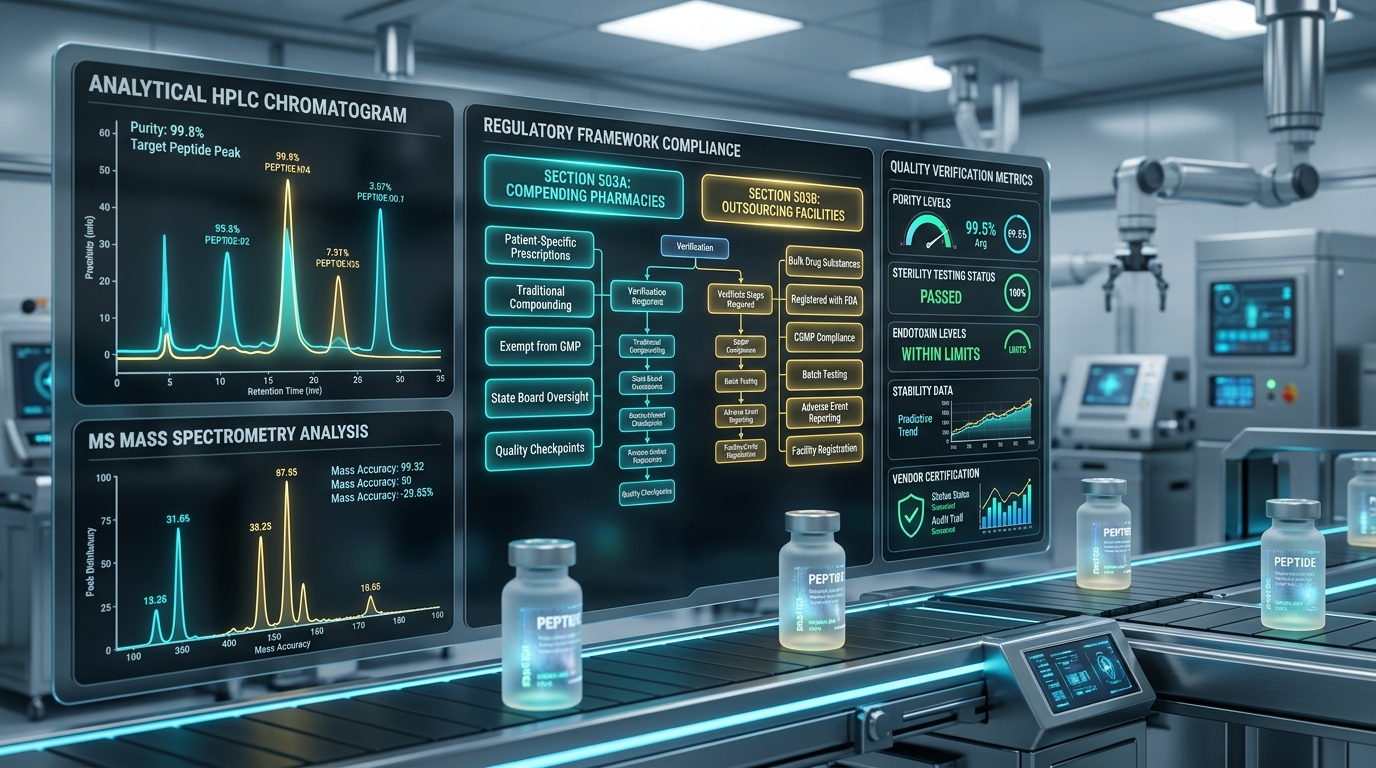
| Issue | Section 503A | Section 503B |
|---|---|---|
| Typical entity | State-licensed pharmacy or physician, and certain other entities depending on the activity | FDA-registered outsourcing facility |
| Core model | Patient-specific compounding on receipt of a prescription | Sterile-drug compounding at scale in a registered facility |
| Patient-specific prescription | Central to the statutory conditions | Not required for every product; office stock distribution is permitted under applicable conditions |
| Federal CGMP | Exemption available when the section's conditions are met | No exemption, CGMP applies |
| FDA registration | Not registered as an outsourcing facility | Must elect and maintain outsourcing-facility registration |
| Inspection | FDA and state oversight depending on activity and jurisdiction | Risk-based FDA inspection, plus state requirements |
| Bulk drug substances | Governed by the separate Section 503A bulk-substance framework and applicable conditions | Generally limited to 503B Bulks List substances, or products on the shortage list at the required times |
| Distribution | Patient-specific dispensing and other legally permitted activity | May distribute to healthcare practitioners as permitted under Section 503B |
| Reporting | Different framework | Product reporting and adverse-event reporting obligations |
| Buyer's diligence focus | 503A conditions and state-law requirements | Registration status, CGMP posture, list and shortage status, documentation, reporting history |
FDA has been direct that a facility registering under Section 503B is electing to operate under that section. Drugs compounded there are not eligible for Section 503A exemptions simply because a patient-specific prescription happens to exist.
On the phrase "503B pharmacy"
"503B pharmacy" is how a large share of professional searches are phrased, and it is a reasonable thing to type into a search box. It is not the preferred term. An outsourcing facility is not required to be a licensed pharmacy, although compounding must be performed by or under the direct supervision of a licensed pharmacist. "503B outsourcing facility" or "FDA-registered outsourcing facility" is the accurate phrasing, and it is worth using in contracts, quality agreements and supplier files even where colloquial usage prevails in conversation.
Clinics and med spas
A clinic or med spa is not automatically a 503A compounder, a 503B outsourcing facility, a pharmacy, or an entity authorized to purchase any given category of material. It may be a customer of an outsourcing facility, a healthcare practice, a distributor, or something else entirely, and its obligations depend on the specific entity, licence, activity, product and jurisdiction. Marketing labels do not establish regulatory classification. This is not a technicality; entity misclassification is one of the more common failure points in B2B peptide and compounding supply relationships, and it usually surfaces at the worst moment.
What the 2026 GLP-1 Regulatory Changes Mean for B2B Procurement
The honest answer for most organizations is: less than the headlines suggest, and more than nothing.
If your organization is an outsourcing facility that stopped compounding these substances when the shortage windows closed in 2025, the April 2026 proposal changes no present obligation. What it changes is your planning horizon. A firm that had been holding open the possibility of a future Bulks List inclusion, retaining supplier relationships, deferring equipment decisions, keeping a line item warm, now has a clear signal about how FDA reads the clinical-need standard for approved-product GLP-1s. That signal is planning-relevant even before it is legally operative.
If your organization purchases research-use-only material for laboratory work, the proposal does not apply to your activity at all, and any supplier suggesting otherwise in either direction is telling you something about their compliance posture. RUO procurement and human-drug compounding are separate supply chains with separate documentation standards, and the boundary between them should be visible in your records, not merely assumed.
What genuinely warrants attention across both cases is process rather than substance. The 2026 sequence, proposal, extension, pending determination, is a reminder that regulatory status is a dated variable, not a fixed attribute of a material. Most procurement systems record supplier attributes as though they were permanent. Few record the date on which a legal status was last confirmed, or the source consulted.
Reverify status before you change anything
Before a substitution, a new supplier, a contract renewal or an inventory commitment, re-check the substance's position against primary sources and write down what you found: the source URL, the date checked, the substance, the formulation and route, the list status, the shortage status, and whether the action you are relying on is proposed or final. That record is the thing that makes a later decision defensible. Its absence is what makes an otherwise reasonable decision indefensible in hindsight.
Do not treat supplier documentation as regulatory clearance
This deserves its own line because it is where commercial and legal reasoning most often blur. A supplier can furnish excellent analytical documentation for a material that your organization is not permitted to use for the purpose you have in mind. The two questions are independent, and answering the first well does not answer the second at all.
Reduce single-source exposure
Continuity planning is legitimate and, done properly, has nothing to do with circumventing a restriction. It means maintaining a watchlist of the regulatory sources that bear on your materials, qualifying lawful alternatives before you need them, avoiding dependence on one vendor for a critical input, documenting substitute-material reviews, and building change-notification obligations into contracts so a supplier-side change reaches your quality team rather than surprising it.
What continuity does not mean is searching for a route around a list restriction. If the lawful pathway for a material closes for your entity and activity, the answer is to stop, not to reroute.
Review contracts and customer-facing claims
Regulatory movement is a reasonable trigger for reviewing supply agreements, quality agreements, and the claims your own organization makes downstream. Where a contract assumes a status that may change, the assumption should be surfaced. Where marketing copy has drifted toward implying authorization that documentation cannot support, this is the moment to pull it back.
What Should B2B Buyers Verify Before Sourcing?
It helps to keep three categories separate, because pages that blend them tend to overstate obligations in some places and understate them in others.
Statutory conditions. Section 503B sets bulk-substance conditions beyond the list itself. Where an applicable USP or NF monograph exists, the substance must meet it. The substance must be manufactured by an establishment registered under Section 510. And it must be accompanied by a valid certificate of analysis. These are conditions of the framework, not procurement preferences.
FDA expectations and guidance. FDA's compounding guidance documents, including its interim policy on compounding using bulk drug substances under Section 503B, set out how the agency approaches substances pending evaluation. Guidance describes FDA's current thinking rather than binding law, but a facility that ignores it is choosing a harder conversation during inspection.
Good procurement practice. Everything else on the list below falls here. None of it is a statutory requirement in itself; all of it is what a competent buyer does.
- Entity and activity classification, documented rather than assumed
- Intended use, stated explicitly and matched against the material's permitted use
- Supplier corporate identity, facility location and manufacturing origin
- Registration status where relevant, verified against FDA's registered outsourcing facility database rather than against the supplier's own claim
- Inspection and enforcement history where publicly available, including Form 483 observations and warning letters
- Lot-specific COA with a lot number that matches the material received
- Identity confirmation, purity and assay results, impurity profile, and the analytical methods used
- Testing laboratory identity and independence from the manufacturer
- Manufacture date, retest or expiry date, storage conditions and shipping records
- Chain-of-custody documentation
- Deviation and out-of-specification history
- Change-notification and recall procedures, in writing
What a COA Can and Cannot Establish
A certificate of analysis is analytical documentation. It is not legal authorization, and it never becomes legal authorization regardless of how good the numbers are.
This is the most consequential misunderstanding in B2B peptide and bulk-substance supply, and it is usually honest rather than cynical. A buyer receives a lot-specific COA showing reversed-phase HPLC purity above 99% with LC-MS identity confirmation from an independent laboratory, and reasonably concludes that the material is of high quality. That conclusion is correct. The error is the next inference, that quality of this order implies permission to use the material for a particular regulated purpose.
A well-constructed COA supports claims about identity, purity and assay, impurity profile, and the methods and laboratory that produced those figures. It ties those findings to a specific lot, which is what makes traceability possible.
What it cannot do: establish that a substance is on the 503B Bulks List, establish that a compounded product is on the shortage list, establish the buyer's entity classification, satisfy state-law requirements, or convert research-use-only material into material authorized for human-drug compounding. A purity figure describes a molecule. It says nothing about a pathway.
For a fuller treatment of how to read one, see the certificate of analysis guide and the documented testing and quality standards behind 99 Purity Wholesale's own batch-matched COAs, which are produced by Freedom Diagnostic using reversed-phase HPLC and LC-MS.
Procurement Continuity Without Regulatory Guesswork
Continuity, in this context, is a governance problem rather than a sourcing problem. The organizations that handled the 2024 to 2026 GLP-1 sequence well were not the ones that predicted FDA correctly. They were the ones whose files could show, on any given date, what they had checked and when.
Practically, that looks like: a named owner for regulatory monitoring; a short list of primary sources checked on a defined cadence rather than when something goes wrong; dated status records attached to materials rather than held in someone's memory; qualified alternatives identified before they are needed; contract terms that require suppliers to notify you of relevant changes; and a defined escalation path to qualified counsel or regulatory personnel when a question exceeds what procurement can resolve.
None of this is exotic. Most of it is cheap. Almost all of it is easier to build before a determination lands than after.
What the FDA Proposal Does Not Mean
A short list of inferences the April 2026 notice does not support:
- A proposal is not a final rule. FDA has stated it will publish a separate final determination. Until that appears, describing the exclusion as complete misstates the record.
- 503B is not every compounding pharmacy. Section 503A and Section 503B are separate frameworks with separate conditions.
- 503B status is not FDA product approval. Compounded drugs are not FDA-approved, and outsourcing-facility registration does not change that.
- A COA is not legal authorization, and high purity is not legal authorization either.
- A clinic is not automatically a 503B outsourcing facility. Neither is a med spa.
- Research-use-only material is not authorized for human use. It is a different category of supply with different terms, and the distinction is not a formality.
- Absence from the Bulks List does not answer every compounding question, because the shortage pathway, essentially-a-copy restrictions, formulation, entity status and state law all sit alongside it.
What B2B Teams Should Monitor Next
Six sources, checked on a cadence, will cover most of what matters:
- Docket FDA-2018-N-3240 on Regulations.gov and the Federal Register, for a final determination on these three substances.
- FDA's 503B Bulk Drug Substances List page, bearing in mind its current August 2023 notation. A change to that stamp is itself a signal.
- FDA's Drug Shortages Database, at the presentation level, particularly for liraglutide.
- FDA's registered outsourcing facilities list, for supplier registration, inspection and Form 483 information.
- FDA compounding policy and enforcement pages, including warning letters, which have been active in this area.
- State boards of pharmacy, which impose requirements federal sources will not tell you about.
Related reading on adjacent questions: peptide sourcing and the 2026 FDA regulatory shifts, what compounding pharmacies should know about research-grade sourcing, and the supplier verification process.
A note on this article. This is general information for B2B procurement and compliance readers. It is not legal advice, and it does not establish that any material may lawfully be used for any particular purpose by any particular entity. All compounds supplied by 99 Purity Wholesale are for laboratory research and analytical use by qualified professionals; they are not FDA-approved and are not intended for human or veterinary use. Entity classification, product eligibility and permitted use should be confirmed with qualified counsel or regulatory personnel against primary sources and applicable state law.
Regulatory status verified against FDA and Federal Register sources on September 10, 2026.
