
Clinical Research & Reference Standard Compendium
Metabolic Activation - Scientific Literature
I. Abstract & Overview
Metabolic Activation suministra SLU-PP-332 (10 mg), 5-Amino-1MQ (50 mg), NAD+ (100 mg) y MOTS-c (10 mg) en cuatro viales etiquetados por separado. Solo un componente es un péptido. El kit se organiza en torno a cuatro clases de diana distintas que alcanzan un mismo sistema metabólico — agonismo de receptor nuclear, inhibición de sitio activo enzimático, suministro de cofactor redox y señalización por péptido codificado en la mitocondria. SLU-PP-332 actúa sobre receptores nucleares huérfanos sin ligando endógeno conocido, situándolo en una categoría experimental distinta de todo péptido de esta gama. Uso Exclusivo de Investigación.
II. Chemical Specifications
| Molecular Formula | Blend — no single formula applies; SLU-PP-332 C18H14N2O2, 5-Amino-1MQ C11H13N2 as the quaternary cation, NAD+ C21H27N7O14P2, MOTS-c C101H152N28O22S2 |
|---|---|
| Molar Mass | SLU-PP-332 290.3 g/mol; 5-Amino-1MQ 173.2 g/mol as the free cation; NAD+ 663.4 g/mol; MOTS-c 2174.6 g/mol — verify salt forms with manufacturer COA |
| CAS Registry Number | Blend |
| Amino Acid Sequence | MOTS-c Met-Arg-Trp-Gln-Glu-Met-Gly-Tyr-Ile-Phe-Tyr-Pro-Arg-Lys-Leu-Arg; SLU-PP-332 y 5-Amino-1MQ son moléculas pequeñas y NAD+ un cofactor dinucleótido — ninguno es un péptido |
III. Mechanism & Cellular Signaling Pathways
SLU-PP-332 es un agonista sintético de los subtipos alfa, beta y gamma del receptor relacionado con estrógenos. Son receptores nucleares que regulan la transcripción directamente, y Billon y colaboradores mostraron que el compuesto produce una respuesta aeróbica aguda dependiente de ERR-alfa — la razón por la que la literatura lo describe como mimético del ejercicio. 5-Amino-1MQ inhibe la nicotinamida N-metiltransferasa, enzima que consume el fondo de donantes de metilo. NAD+ entra como sustrato de sirtuinas y enzimas PARP y no como regulador. MOTS-c se transcribe desde el ADN mitocondrial y, según demostraron Kim y colaboradores, se transloca al núcleo para alterar la expresión génica nuclear bajo estrés metabólico.
IV. Primary Research Directions
- El único kit de este catálogo construido en torno a una diana de receptor nuclear, dando lecturas transcripcionales en una escala temporal que ningún agonista de superficie de esta gama produce
- SLU-PP-332 actúa sobre receptores huérfanos sin ligando endógeno conocido, convirtiéndolo en una herramienta química genuina y no en un análogo hormonal
- Cuatro protocolos de liberación distintos ajustados a la química — LC-MS peptídico, dos confirmaciones estructurales de molécula pequeña e identidad espectral UV a 260 nanómetros para el dinucleótido
- MOTS-c suministrado como el único componente codificado mitocondrialmente, transcrito fuera del genoma nuclear a diferencia de todo otro péptido de este catálogo
- Datos publicados de referencia de metabolitos antidopaje para SLU-PP-332, inusual en un compuesto descrito por primera vez en 2023 y útil para verificación independiente de identidad
V. Frequently Asked Questions (FAQs)
Q: ¿Cuál es el grado principal de estos compuestos?
Todos los compuestos son estándares de referencia analíticos sintetizados a un nivel de pureza de ≥99.0%, verificado por HPLC y espectrometría de masas.
Q: ¿Están estos péptidos destinados al consumo humano?
No. Bajo ninguna circunstancia este material debe utilizarse para el consumo humano con fines de diagnóstico, terapéuticos o recreativos. La investigación muestra que la administración a organismos vivos está estrictamente restringida a ensayos de laboratorio e in-vitro aprobados.
Q: ¿Cómo muestra la investigación que deben almacenarse estos péptidos?
La investigación muestra que los péptidos liofilizados son estables a temperatura ambiente por períodos cortos, pero deben almacenarse a -20°C para estabilidad a largo plazo. Una vez reconstituidos, deben mantenerse de 2°C a 8°C y usarse dentro de una ventana limitada para evitar la degradación.
Q: ¿Qué es la reconstitución y qué disolvente debe utilizarse?
La reconstitución es el proceso de disolver el polvo liofilizado. La investigación muestra que el agua bacteriostática estéril o la solución salina fisiológica estéril son los disolventes estándar utilizados para preservar la estabilidad de los péptidos y prevenir el crecimiento microbiano.
Q: ¿Qué representa el cromatograma HPLC?
El cromatograma HPLC (Cromatografía Líquida de Alta Resolución) representa el perfil de pureza molecular del lote. La investigación muestra que un único pico dominante con un área de pureza de ≥99% indica la ausencia de subproductos de síntesis y contaminantes.
Q: ¿Se pueden combinar estos compuestos de investigación en un solo estudio?
Sí. La investigación preclínica muestra que ciertos péptidos, como el BPC-157 y el TB-500, exhiben vías de señalización sinérgicas durante la reparación de tejidos. Sin embargo, la administración dual debe calibrarse cuidadosamente en modelos de laboratorio.
Q: ¿Por qué es importante la variación de la masa molar y la fórmula molecular?
La fórmula molecular y la masa molar son identificadores dactilares. La investigación muestra que verificar estas propiedades mediante espectrometría de masas garantiza la integridad estructural de la secuencia del péptido, confirmando que coincide con el estándar de referencia.
Q: ¿Qué documentación se proporciona para el cumplimiento regulatorio?
Cada envío va acompañado de un Certificado de Análisis (COA) específico del lote que contiene la verificación de pureza por HPLC, la validación estructural por espectrometría de masas y las hojas de datos de seguridad (SDS) para el cumplimiento del laboratorio.
VI. Academic Citations
- Billon, C., Sitaula, S., Banerjee, S., et al. (2023). 'Synthetic ERRα/β/γ Agonist Induces an ERRα-Dependent Acute Aerobic Exercise Response and Enhances Exercise Capacity.' ACS Chemical Biology, 18(4), 756-771. DOI: 10.1021/acschembio.2c00720 | PMID: 36988910
- Neelakantan, H., Vance, V., Wetzel, M. D., et al. (2018). 'Selective and membrane-permeable small molecule inhibitors of nicotinamide N-methyltransferase reverse high fat diet-induced obesity in mice.' Biochemical Pharmacology, 147, 141-152. DOI: 10.1016/j.bcp.2017.11.007 | PMID: 29155147
- Lee, C., Zeng, J., Drew, B. G., et al. (2015). 'The mitochondrial-derived peptide MOTS-c promotes metabolic homeostasis and reduces obesity and insulin resistance.' Cell Metabolism, 21(3), 443-454. DOI: 10.1016/j.cmet.2015.02.009 | PMID: 25738459
Metabolic Activation
Resumen y Descripción General
Metabolic Activation suministra SLU-PP-332 (10 mg), 5-Amino-1MQ (50 mg), NAD+ (100 mg) y MOTS-c (10 mg) en cuatro viales etiquetados por separado. Solo un componente es un péptido. El kit se organiza en torno a cuatro clases de diana distintas que alcanzan un mismo sistema metabólico — agonismo de receptor nuclear, inhibición de sitio activo enzimático, suministro de cofactor redox y señalización por péptido codificado en la mitocondria. SLU-PP-332 actúa sobre receptores nucleares huérfanos sin ligando endógeno conocido, situándolo en una categoría experimental distinta de todo péptido de esta gama. Uso Exclusivo de Investigación.
Especificaciones Técnicas
Verificación HPLC del Lote
CROMATOGRAMA DE REFERENCIA HPLC (ESTÁNDAR ANALÍTICO)
Perfil analítico de alta resolución correspondiente a la pureza del lote de este compuesto. La integración del área del pico confirma una pureza ≥99.0%.
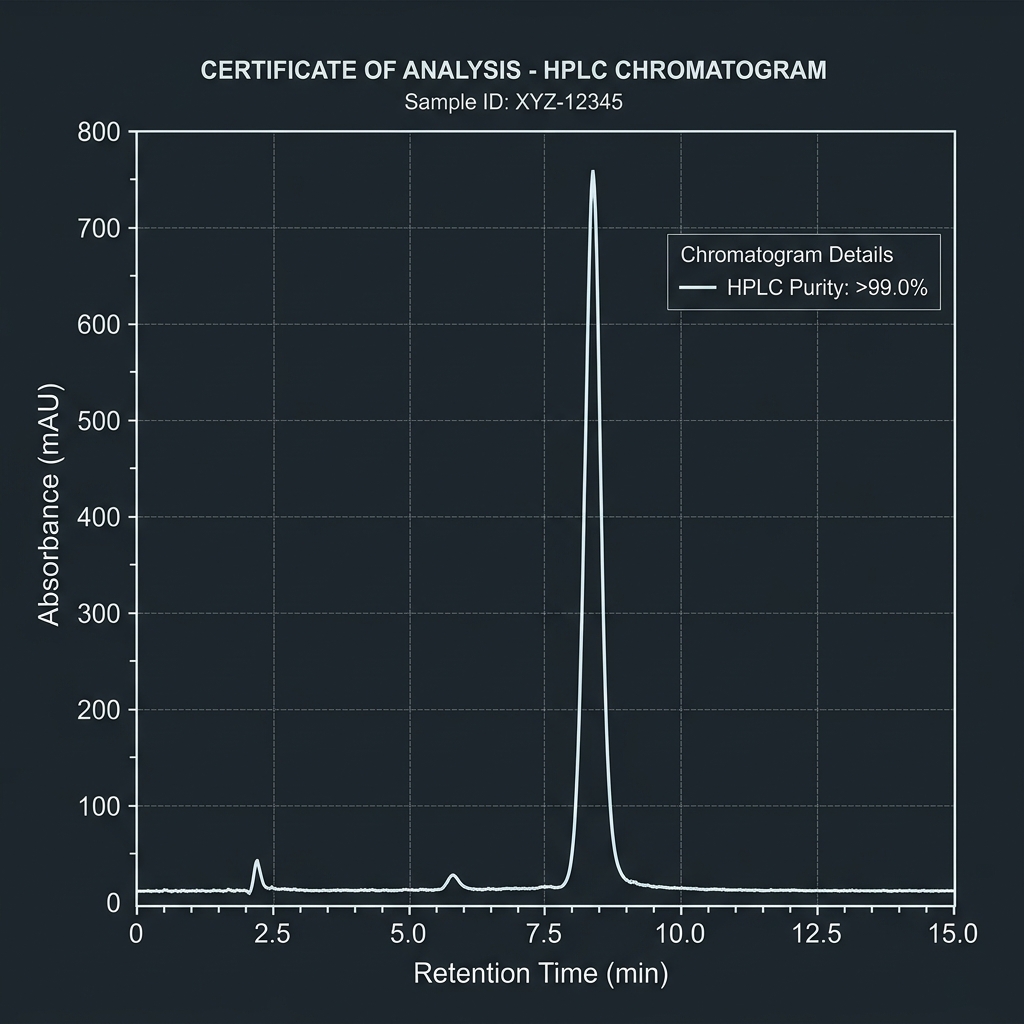
Crédito y Fuente de la Imagen: Espectro de referencia compilado de la base de datos de compuestos PubChem en el Centro Nacional para la Información Biotecnológica (NCBI). Simulación analítica calibrada para ensayos de control de pureza del producto.
Condiciones del Método HPLC
| Peak | Tiempo de Retención | Area (mAU*s) | Area % |
|---|---|---|---|
| 1 (Impurity) | 2.10 | 12.5 | 0.35% |
| 2 (Metabolic Activation) | 4.10 | 3562.4 | 99.65% |
Guía de Lectura: ¿Qué demuestra este Cromatograma?
El pico alto a los 4.10 min representa a Metabolic Activation. Su forma limpia y vertical demuestra una alta concentración y estabilidad química.
El área total bajo el pico principal constituye el 99.65% de la muestra. Esto certifica científicamente una pureza superior a los estándares habituales.
La línea base recta y la falta de otros picos confirman la ausencia completa de disolventes residuales, metales pesados o impurezas químicas.
Mecanismo y Señalización
SLU-PP-332 es un agonista sintético de los subtipos alfa, beta y gamma del receptor relacionado con estrógenos. Son receptores nucleares que regulan la transcripción directamente, y Billon y colaboradores mostraron que el compuesto produce una respuesta aeróbica aguda dependiente de ERR-alfa — la razón por la que la literatura lo describe como mimético del ejercicio. 5-Amino-1MQ inhibe la nicotinamida N-metiltransferasa, enzima que consume el fondo de donantes de metilo. NAD+ entra como sustrato de sirtuinas y enzimas PARP y no como regulador. MOTS-c se transcribe desde el ADN mitocondrial y, según demostraron Kim y colaboradores, se transloca al núcleo para alterar la expresión génica nuclear bajo estrés metabólico.
Direcciones Primarias de Investigación
El único kit de este catálogo construido en torno a una diana de receptor nuclear, dando lecturas transcripcionales en una escala temporal que ningún agonista de superficie de esta gama produce
SLU-PP-332 actúa sobre receptores huérfanos sin ligando endógeno conocido, convirtiéndolo en una herramienta química genuina y no en un análogo hormonal
Cuatro protocolos de liberación distintos ajustados a la química — LC-MS peptídico, dos confirmaciones estructurales de molécula pequeña e identidad espectral UV a 260 nanómetros para el dinucleótido
MOTS-c suministrado como el único componente codificado mitocondrialmente, transcrito fuera del genoma nuclear a diferencia de todo otro péptido de este catálogo
Datos publicados de referencia de metabolitos antidopaje para SLU-PP-332, inusual en un compuesto descrito por primera vez en 2023 y útil para verificación independiente de identidad
Preguntas Frecuentes
Análisis científico y respuestas técnicas sobre los compuestos.
¿Cuál es el grado principal de estos compuestos?
Todos los compuestos son estándares de referencia analíticos sintetizados a un nivel de pureza de ≥99.0%, verificado por HPLC y espectrometría de masas.
02¿Están estos péptidos destinados al consumo humano?
+
¿Están estos péptidos destinados al consumo humano?
No. Bajo ninguna circunstancia este material debe utilizarse para el consumo humano con fines de diagnóstico, terapéuticos o recreativos. La investigación muestra que la administración a organismos vivos está estrictamente restringida a ensayos de laboratorio e in-vitro aprobados.
03¿Cómo muestra la investigación que deben almacenarse estos péptidos?
+
¿Cómo muestra la investigación que deben almacenarse estos péptidos?
La investigación muestra que los péptidos liofilizados son estables a temperatura ambiente por períodos cortos, pero deben almacenarse a -20°C para estabilidad a largo plazo. Una vez reconstituidos, deben mantenerse de 2°C a 8°C y usarse dentro de una ventana limitada para evitar la degradación.
04¿Qué es la reconstitución y qué disolvente debe utilizarse?
+
¿Qué es la reconstitución y qué disolvente debe utilizarse?
La reconstitución es el proceso de disolver el polvo liofilizado. La investigación muestra que el agua bacteriostática estéril o la solución salina fisiológica estéril son los disolventes estándar utilizados para preservar la estabilidad de los péptidos y prevenir el crecimiento microbiano.
05¿Qué representa el cromatograma HPLC?
+
¿Qué representa el cromatograma HPLC?
El cromatograma HPLC (Cromatografía Líquida de Alta Resolución) representa el perfil de pureza molecular del lote. La investigación muestra que un único pico dominante con un área de pureza de ≥99% indica la ausencia de subproductos de síntesis y contaminantes.
06¿Se pueden combinar estos compuestos de investigación en un solo estudio?
+
¿Se pueden combinar estos compuestos de investigación en un solo estudio?
Sí. La investigación preclínica muestra que ciertos péptidos, como el BPC-157 y el TB-500, exhiben vías de señalización sinérgicas durante la reparación de tejidos. Sin embargo, la administración dual debe calibrarse cuidadosamente en modelos de laboratorio.
07¿Por qué es importante la variación de la masa molar y la fórmula molecular?
+
¿Por qué es importante la variación de la masa molar y la fórmula molecular?
La fórmula molecular y la masa molar son identificadores dactilares. La investigación muestra que verificar estas propiedades mediante espectrometría de masas garantiza la integridad estructural de la secuencia del péptido, confirmando que coincide con el estándar de referencia.
08¿Qué documentación se proporciona para el cumplimiento regulatorio?
+
¿Qué documentación se proporciona para el cumplimiento regulatorio?
Cada envío va acompañado de un Certificado de Análisis (COA) específico del lote que contiene la verificación de pureza por HPLC, la validación estructural por espectrometría de masas y las hojas de datos de seguridad (SDS) para el cumplimiento del laboratorio.
Citas Científicas
Billon, C., Sitaula, S., Banerjee, S., et al. (2023). 'Synthetic ERRα/β/γ Agonist Induces an ERRα-Dependent Acute Aerobic Exercise Response and Enhances Exercise Capacity.' ACS Chemical Biology, 18(4), 756-771. DOI: 10.1021/acschembio.2c00720 | PMID: 36988910
Neelakantan, H., Vance, V., Wetzel, M. D., et al. (2018). 'Selective and membrane-permeable small molecule inhibitors of nicotinamide N-methyltransferase reverse high fat diet-induced obesity in mice.' Biochemical Pharmacology, 147, 141-152. DOI: 10.1016/j.bcp.2017.11.007 | PMID: 29155147
Lee, C., Zeng, J., Drew, B. G., et al. (2015). 'The mitochondrial-derived peptide MOTS-c promotes metabolic homeostasis and reduces obesity and insulin resistance.' Cell Metabolism, 21(3), 443-454. DOI: 10.1016/j.cmet.2015.02.009 | PMID: 25738459
Descargo de Responsabilidad Académico
Todos los compuestos suministrados por 99 Purity Wholesale se producen estrictamente para fines de investigación de laboratorio, análisis químico y experimentación in-vitro. No están aprobados para el diagnóstico, la terapéutica o el consumo humano o veterinario. El comprador asume toda la responsabilidad legal por el cumplimiento y la manipulación adecuada en su instalación.
