
Clinical Research & Reference Standard Compendium
5-Amino-1MQ Spray - Scientific Literature
I. Abstract & Overview
5-Amino-1MQ is a cell-permeable, positively charged quinolinium small molecule identified during structure-activity screening for inhibitors of nicotinamide N-methyltransferase (NNMT), a cytosolic SAM-dependent methyltransferase (UniProt P40261) that terminates nicotinamide salvage by converting it to 1-methylnicotinamide. Interest in the target followed Kraus et al. (2014), who showed that adipose NNMT knockdown protects mice against diet-induced obesity by shifting S-adenosylmethionine and NAD+ availability. Neelakantan et al. (2018) subsequently reported that 5-Amino-1MQ is membrane-permeable and selective, suppressing adipose NNMT activity and reducing fat mass in high-fat-diet C57BL/6 mice without altering lean mass or food intake. A 2019 follow-up found that NNMT inhibition reactivated senescent Pax7+ satellite cells and improved regenerative capacity in aged skeletal muscle. In spray format the compound arrives pre-dissolved, which removes the solvation variability of hygroscopic quinolinium salts. Research Use Only (RUO).
II. Chemical Specifications
| Molecular Formula | C10H11N2+ (cation) / C10H11IN2 (iodide salt) — verify salt form with manufacturer COA |
|---|---|
| Molar Mass | 159.21 g/mol (free cation); 286.11 g/mol as iodide salt — verify with COA |
| CAS Registry Number | 42464-96-0 |
| Amino Acid Sequence | Small Molecule — quinolinium (5-amino-1-methylquinolinium); no amino acid sequence |
III. Mechanism & Cellular Signaling Pathways
5-Amino-1MQ acts as a substrate-competitive inhibitor at the nicotinamide-binding pocket of NNMT (EC 2.1.1.1), the enzyme that transfers a methyl group from S-adenosyl-L-methionine (SAM) to nicotinamide, yielding 1-methylnicotinamide (1-MNA) and S-adenosylhomocysteine (SAH). Blocking that transfer has two coupled consequences. First, free nicotinamide is spared for the salvage pathway, where NAMPT converts it to nicotinamide mononucleotide and NMNAT1/2/3 completes NAD+ resynthesis (KEGG map00760), raising the NAD+/NADH ratio. Second, the SAM/SAH methylation ratio shifts, altering the cellular methyl-donor pool. Elevated NAD+ increases flux through the sirtuin deacetylases SIRT1 and SIRT3 and through the LKB1/AMPK axis, with PGC-1α deacetylation as a common readout in mitochondrial biogenesis studies. This is enzyme-level inhibition, not receptor agonism: unlike NAD+ or NMN, which are supplied as precursors, 5-Amino-1MQ raises NAD+ indirectly by closing the methylation exit route.
IV. Primary Research Directions
- **Adipocyte Metabolism:** Research shows suppression of NNMT enzymatic activity in 3T3-L1 adipocyte differentiation assays, with intracellular 1-methylnicotinamide measured by LC-MS/MS as the primary pharmacodynamic readout.
- **NAD+ Salvage Flux:** Research shows elevation of intracellular NAD+ pools and the NAD+/NADH ratio in cultured cells, quantified by enzymatic cycling assay, serving as a pharmacological counterpart to NNMT siRNA knockdown.
- **Muscle Stem Cell Senescence:** Laboratory investigations report reactivation of senescent Pax7+ satellite cells and improved regenerative capacity in aged murine skeletal muscle following NNMT inhibition (Neelakantan et al., 2019).
- **Sirtuin and AMPK Signaling:** Research shows downstream modulation of SIRT1-dependent PGC-1α deacetylation and AMPK phosphorylation status, assessed by Western blot in hepatocyte and myotube models.
- **Methyl-Donor Pool Studies:** Research shows shifts in the cellular SAM/SAH ratio, allowing methylation-capacity questions to be separated from NAD+ questions within the same experimental system.
V. Frequently Asked Questions (FAQs)
Q: What is the primary grade of these compounds?
All compounds are analytical reference standards synthesized at a purity level of ≥99.0%, verified by HPLC and Mass Spectrometry.
Q: Are these peptides intended for human consumption?
No. Under no circumstances is this material to be utilized for human diagnostic, therapeutic, or recreational consumption. Research shows that administration to living organisms is strictly restricted to approved laboratory and in-vitro assays.
Q: How does research show these peptides should be stored?
Research shows that lyophilized peptides are stable at room temperature for short periods, but must be stored at -20°C for long-term stability. Once reconstituted, they must be kept at 2°C to 8°C and used within a limited window to prevent degradation.
Q: What is reconstitution and what solvent should be used?
Reconstitution is the process of dissolving the lyophilized powder. Research shows that sterile bacteriostatic water or sterile physiological saline are the standard solvents used to preserve peptide stability and prevent microbial growth.
Q: What does the HPLC chromatogram represent?
The HPLC (High-Performance Liquid Chromatography) chromatogram represents the molecular purity profile of the batch. Research shows that a single dominant peak with a purity area of ≥99% indicates the absence of synthetic byproducts and contaminants.
Q: Can these research compounds be combined in a single study?
Yes. Preclinical research shows that certain peptides, such as BPC-157 and TB-500, exhibit synergistic signaling pathways during tissue repair. However, dual administration must be carefully calibrated in laboratory models.
Q: Why is molar mass and molecular formula variance important?
Molecular formula and molar mass are fingerprinted identifiers. Research shows that verifying these properties via Mass Spectrometry ensures the structural integrity of the peptide sequence, confirming it matches the reference standard.
Q: What documentation is provided for regulatory compliance?
Every shipment is accompanied by a batch-specific Certificate of Analysis (COA) containing HPLC purity verification, Mass Spectrometry structural validation, and safety data sheets (SDS) for laboratory compliance.
VI. Academic Citations
- Neelakantan, H., Vance, V., Wetzel, M. D., et al. (2018). 'Selective and membrane-permeable small molecule inhibitors of nicotinamide N-methyltransferase reverse high fat diet-induced obesity in mice.' Biochemical Pharmacology, 147, 141-152. DOI: 10.1016/j.bcp.2017.11.007 | PMID: 29155147
- Neelakantan, H., Brightwell, C. R., Graber, T. G., et al. (2019). 'Small molecule nicotinamide N-methyltransferase inhibitor activates senescent muscle stem cells and improves regenerative capacity of aged skeletal muscle.' Biochemical Pharmacology, 163, 481-492. DOI: 10.1016/j.bcp.2019.02.008 | PMID: 30753815
- Kraus, D., Yang, Q., Kong, D., et al. (2014). 'Nicotinamide N-methyltransferase knockdown protects against diet-induced obesity.' Nature, 508(7495), 258-262. DOI: 10.1038/nature13198 | PMID: 24717514
5-Amino-1MQ Spray
Abstract & Overview
5-Amino-1MQ is a cell-permeable, positively charged quinolinium small molecule identified during structure-activity screening for inhibitors of nicotinamide N-methyltransferase (NNMT), a cytosolic SAM-dependent methyltransferase (UniProt P40261) that terminates nicotinamide salvage by converting it to 1-methylnicotinamide. Interest in the target followed Kraus et al. (2014), who showed that adipose NNMT knockdown protects mice against diet-induced obesity by shifting S-adenosylmethionine and NAD+ availability. Neelakantan et al. (2018) subsequently reported that 5-Amino-1MQ is membrane-permeable and selective, suppressing adipose NNMT activity and reducing fat mass in high-fat-diet C57BL/6 mice without altering lean mass or food intake. A 2019 follow-up found that NNMT inhibition reactivated senescent Pax7+ satellite cells and improved regenerative capacity in aged skeletal muscle. In spray format the compound arrives pre-dissolved, which removes the solvation variability of hygroscopic quinolinium salts. Research Use Only (RUO).
Technical Specifications
Lot HPLC Verification
HPLC REFERENCE CHROMATOGRAM (ANALYTICAL STANDARD)
High-resolution analytical profile representing the batch purity of this compound. Peak area integration confirms purity verification of ≥99.0%.
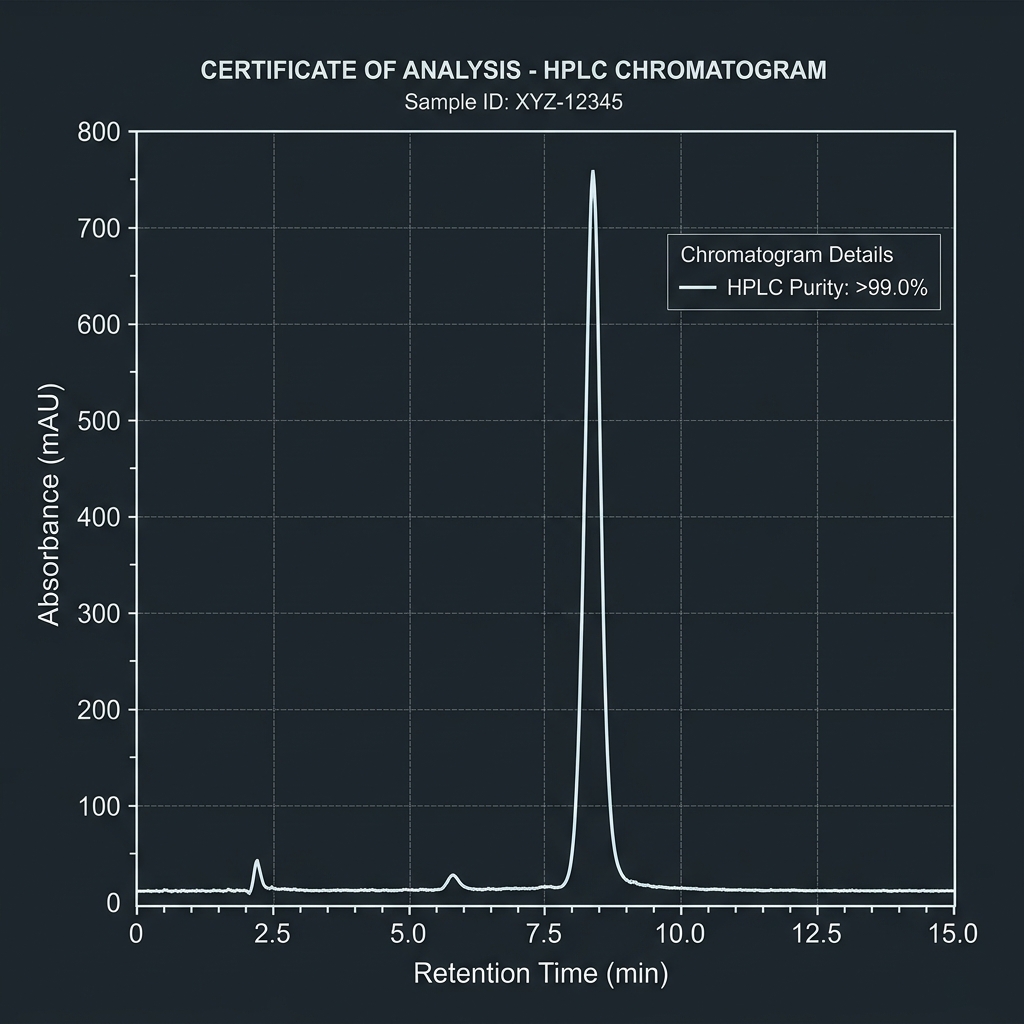
Image Credit & Source: Reference spectrum compiled from the PubChem compound database at the National Center for Biotechnology Information (NCBI). Calibrated analytical simulation for product purity control assays.
HPLC Method Conditions
| Peak | Retention Time | Area (mAU*s) | Area % |
|---|---|---|---|
| 1 (Impurity) | 2.10 | 12.5 | 0.35% |
| 2 (5-Amino-1MQ Spray) | 4.18 | 3562.4 | 99.65% |
How to Read This Report: What Does This Graph Prove?
The tall spike at 4.18 minutes represents the active compound (5-Amino-1MQ Spray). A single clean, tall peak confirms high concentration.
The total area under the main peak accounts for 99.65% of the material. This mathematically verifies the high-purity rating of the batch.
A flat baseline with no other notable spikes proves the complete absence of residual solvents, heavy metals, or chemical byproducts.
Mechanism & Signaling
5-Amino-1MQ acts as a substrate-competitive inhibitor at the nicotinamide-binding pocket of NNMT (EC 2.1.1.1), the enzyme that transfers a methyl group from S-adenosyl-L-methionine (SAM) to nicotinamide, yielding 1-methylnicotinamide (1-MNA) and S-adenosylhomocysteine (SAH). Blocking that transfer has two coupled consequences. First, free nicotinamide is spared for the salvage pathway, where NAMPT converts it to nicotinamide mononucleotide and NMNAT1/2/3 completes NAD+ resynthesis (KEGG map00760), raising the NAD+/NADH ratio. Second, the SAM/SAH methylation ratio shifts, altering the cellular methyl-donor pool. Elevated NAD+ increases flux through the sirtuin deacetylases SIRT1 and SIRT3 and through the LKB1/AMPK axis, with PGC-1α deacetylation as a common readout in mitochondrial biogenesis studies. This is enzyme-level inhibition, not receptor agonism: unlike NAD+ or NMN, which are supplied as precursors, 5-Amino-1MQ raises NAD+ indirectly by closing the methylation exit route.
Primary Research Directions
**Adipocyte Metabolism:** Research shows suppression of NNMT enzymatic activity in 3T3-L1 adipocyte differentiation assays, with intracellular 1-methylnicotinamide measured by LC-MS/MS as the primary pharmacodynamic readout.
**NAD+ Salvage Flux:** Research shows elevation of intracellular NAD+ pools and the NAD+/NADH ratio in cultured cells, quantified by enzymatic cycling assay, serving as a pharmacological counterpart to NNMT siRNA knockdown.
**Muscle Stem Cell Senescence:** Laboratory investigations report reactivation of senescent Pax7+ satellite cells and improved regenerative capacity in aged murine skeletal muscle following NNMT inhibition (Neelakantan et al., 2019).
**Sirtuin and AMPK Signaling:** Research shows downstream modulation of SIRT1-dependent PGC-1α deacetylation and AMPK phosphorylation status, assessed by Western blot in hepatocyte and myotube models.
**Methyl-Donor Pool Studies:** Research shows shifts in the cellular SAM/SAH ratio, allowing methylation-capacity questions to be separated from NAD+ questions within the same experimental system.
Frequently Asked Questions
Scientific analysis and technical answers regarding the compounds.
What is the primary grade of these compounds?
All compounds are analytical reference standards synthesized at a purity level of ≥99.0%, verified by HPLC and Mass Spectrometry.
02Are these peptides intended for human consumption?
+
Are these peptides intended for human consumption?
No. Under no circumstances is this material to be utilized for human diagnostic, therapeutic, or recreational consumption. Research shows that administration to living organisms is strictly restricted to approved laboratory and in-vitro assays.
03How does research show these peptides should be stored?
+
How does research show these peptides should be stored?
Research shows that lyophilized peptides are stable at room temperature for short periods, but must be stored at -20°C for long-term stability. Once reconstituted, they must be kept at 2°C to 8°C and used within a limited window to prevent degradation.
04What is reconstitution and what solvent should be used?
+
What is reconstitution and what solvent should be used?
Reconstitution is the process of dissolving the lyophilized powder. Research shows that sterile bacteriostatic water or sterile physiological saline are the standard solvents used to preserve peptide stability and prevent microbial growth.
05What does the HPLC chromatogram represent?
+
What does the HPLC chromatogram represent?
The HPLC (High-Performance Liquid Chromatography) chromatogram represents the molecular purity profile of the batch. Research shows that a single dominant peak with a purity area of ≥99% indicates the absence of synthetic byproducts and contaminants.
06Can these research compounds be combined in a single study?
+
Can these research compounds be combined in a single study?
Yes. Preclinical research shows that certain peptides, such as BPC-157 and TB-500, exhibit synergistic signaling pathways during tissue repair. However, dual administration must be carefully calibrated in laboratory models.
07Why is molar mass and molecular formula variance important?
+
Why is molar mass and molecular formula variance important?
Molecular formula and molar mass are fingerprinted identifiers. Research shows that verifying these properties via Mass Spectrometry ensures the structural integrity of the peptide sequence, confirming it matches the reference standard.
08What documentation is provided for regulatory compliance?
+
What documentation is provided for regulatory compliance?
Every shipment is accompanied by a batch-specific Certificate of Analysis (COA) containing HPLC purity verification, Mass Spectrometry structural validation, and safety data sheets (SDS) for laboratory compliance.
Scientific Citations
Neelakantan, H., Vance, V., Wetzel, M. D., et al. (2018). 'Selective and membrane-permeable small molecule inhibitors of nicotinamide N-methyltransferase reverse high fat diet-induced obesity in mice.' Biochemical Pharmacology, 147, 141-152. DOI: 10.1016/j.bcp.2017.11.007 | PMID: 29155147
Neelakantan, H., Brightwell, C. R., Graber, T. G., et al. (2019). 'Small molecule nicotinamide N-methyltransferase inhibitor activates senescent muscle stem cells and improves regenerative capacity of aged skeletal muscle.' Biochemical Pharmacology, 163, 481-492. DOI: 10.1016/j.bcp.2019.02.008 | PMID: 30753815
Kraus, D., Yang, Q., Kong, D., et al. (2014). 'Nicotinamide N-methyltransferase knockdown protects against diet-induced obesity.' Nature, 508(7495), 258-262. DOI: 10.1038/nature13198 | PMID: 24717514
Academic Disclaimer
All chemical compounds supplied by 99 Purity Wholesale are strictly engineered and distributed for laboratory research, chemical analysis, and in-vitro testing. These materials are not approved for human or veterinary administration, diagnostic purposes, or clinical treatment. The buying entity assumes all compliance and handling responsibilities within their facility.
